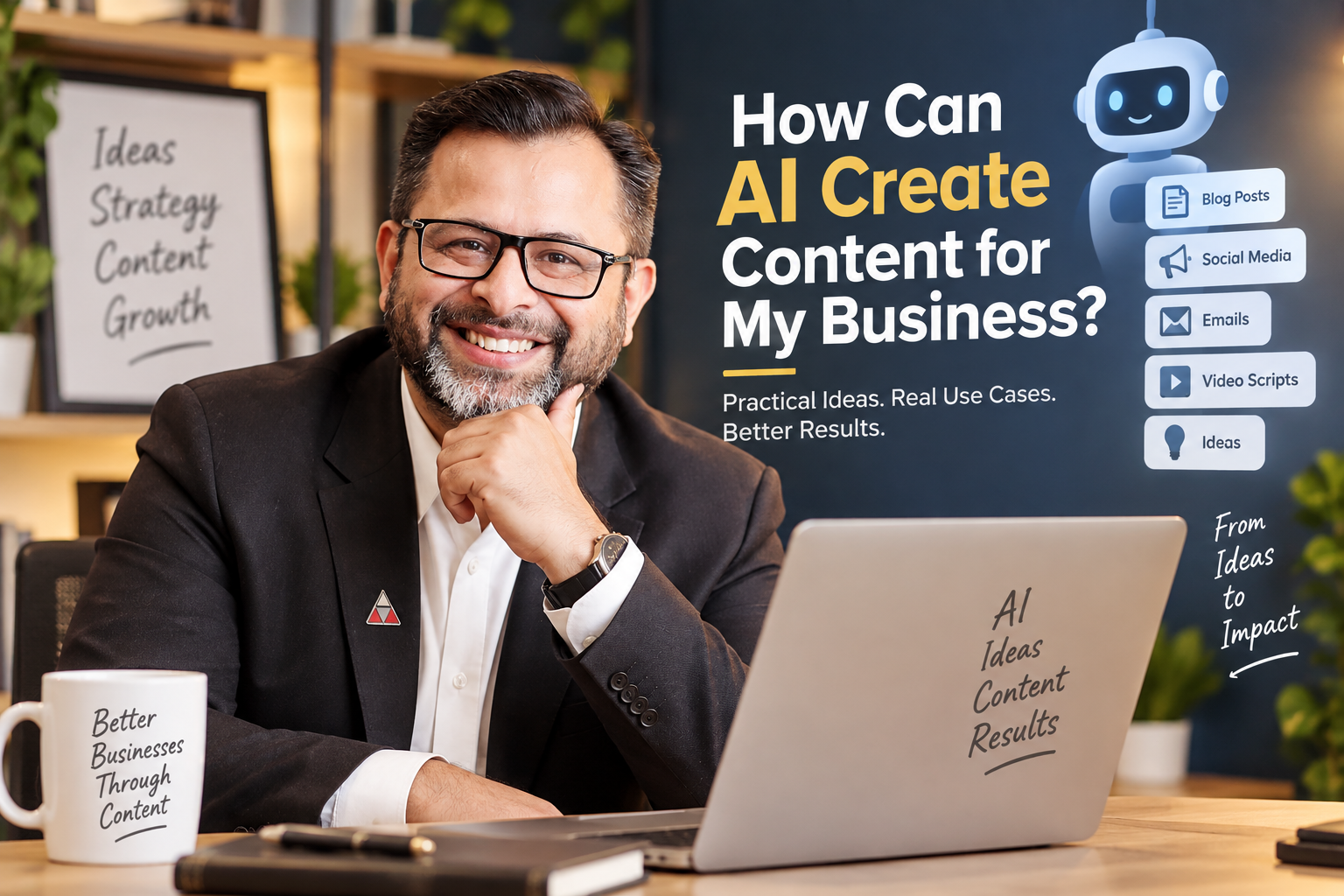
🤖 “Can AI Really Create Useful Content for My Business?”
I hear this question more often now.
Business owners know AI can write.
They have seen it create social media posts, emails, blogs, product descriptions and video scripts within seconds.
So the obvious thought is:
“If AI Can Create Content So Quickly, Why Shouldn’t I Use It for Everything?”
You can certainly use AI to make content creation faster.
But I wouldn’t start by asking:
“Which AI Tool Should I Use?”
I would start with:
🎯 “What Do I Actually Want My Content to Do for My Business?”
Do you want people to discover you?
Do you want to explain your product better?
Do customers keep asking the same questions?
Do you need to stay in touch with existing customers?
Do you want your sales team to have useful content they can share with prospects?
Until that is clear, generating more content may simply give you more content without a clear purpose.
💡 HOW I APPROACH AI CONTENT — SUSHIL ARORA
🤖 When a business owner asks me how AI can create content, I don’t begin with the tool. I first want to understand the customer, the business and what the content is supposed to achieve.
🎯 Then I look at where AI can save time: research support, ideas, first drafts, repurposing, variations and routine content work. The business owner or team still needs to bring the experience, examples, judgement and final approval that make the content genuinely theirs.
🔍 AI Can Write Content. It Doesn’t Automatically Know Your Business.
This is where many businesses get disappointed.
They open an AI tool and type:
“Write an Instagram Post for My Business.”
The tool produces something.
It sounds polished.
There are a few emojis.
There is a call to action.
Technically, the task is complete.
But then you read it and think:
“This Could Have Been Written for Any Business.”
That’s usually the problem.
AI needs context.
It needs to know what you sell, who you sell it to, what customers ask you, what problems they face, how you normally explain your work, and what you want the content to achieve.
💡 If You Give AI Generic Information, Don’t Be Surprised When It Gives You Generic Content.
📌 Where AI Can Actually Help With Business Content
I don’t look at AI as one big “content generator.”
I break the work down.
AI can help with:
📝 First drafts of blogs
📱 Social media posts
📧 Email drafts
🎥 Video and Reel scripts
💡 Content ideas
❓ FAQs
🛍️ Product or service descriptions
♻️ Repurposing existing content
📋 Content outlines
✂️ Shortening long content
🔄 Creating different versions for different channels
But that doesn’t mean every output should be copied and published immediately.
The question I ask is:
🎯 “Which Part Should AI Handle, and Which Part Still Needs My Experience?”
That distinction makes a big difference.
1. Start With Your Customer, Not With AI
Before asking AI to write anything, I want to understand who will read it.
Suppose you run an accounting firm.
You could ask AI:
“Give me 30 content ideas for an accounting business.”
You’ll probably get 30 ideas.
But are those the questions your customers actually care about?
A better starting point is to collect real questions from:
Your sales calls.
Customer emails.
WhatsApp conversations.
Support queries.
Meetings.
Comments on your existing content.
Your team probably hears useful questions every week.
💬 “What Are My Customers Already Asking Me?”
That’s where I would begin.
Those questions can become blogs, posts, videos, FAQs and emails.
AI can then help turn that knowledge into different content formats.
💡 Don’t Ask AI to Guess What Your Customers Care About When Your Customers Are Already Telling You.
2. Give AI Enough Information About Your Business
Imagine two prompts.
The first says:
“Write a post about business automation.”
The second explains the audience, the business problem, the point the post should make, the desired tone, what examples can be used, and what claims should be avoided.
Which one is more likely to produce something useful?
Usually the second.
Before I use AI regularly for a business, I would prepare some basic information:
📌 Who are we talking to?
📌 What do we sell?
📌 Which problems do customers usually bring to us?
📌 How do we normally explain our solutions?
📌 What tone do we use?
📌 Which claims should we never make?
📌 What should the reader understand or do after reading?
This gives AI boundaries.
🤖 AI Works Better When You Give It Context Instead of Expecting It to Understand Your Business Automatically.
3. Use AI to Create a First Draft, Not an Automatic Final Answer
This is one of the biggest changes I would make in how businesses use AI.
Don’t think:
Prompt → Generate → Copy → Publish
I prefer:
Business Idea → AI Draft → Human Review → Business Experience → Edit → Publish
Why?
Because the first draft may sound fine while still missing something important.
It may be too generic.
It may repeat itself.
It may misunderstand the audience.
It may state something that needs checking.
It may sound nothing like the person or company publishing it.
The human review is where you ask:
🔍 “Would I Actually Say This to a Customer?”
If the answer is no, edit it.
✍️ AI Can Help You Get to a Draft Faster. You Still Decide What Represents Your Business.
4. Turn One Good Idea Into Several Pieces of Content
This is one of the areas where I think AI can be genuinely useful.
Suppose you spend 20 minutes explaining an important customer problem.
That one explanation could become:
📖 A blog article
📱 A short LinkedIn post
🎥 A video script
📧 An email
❓ A FAQ answer
💬 Several short social posts
You don’t need to start from zero every time.
♻️ “What Content Do I Already Have That Can Be Used in Another Format?”
Maybe you already have useful material sitting inside:
Recorded meetings.
Webinars.
Presentations.
Old blogs.
Customer questions.
Training material.
Sales explanations.
AI can help restructure and adapt that material.
But I would still check that the shorter versions keep the meaning of the original.
💡 Before Asking AI to Create More, Look at What Your Business Has Already Created.
5. Use AI to Help Build a Content Routine
One reason business content becomes inconsistent is simple.
Everyone gets busy.
Monday comes.
Someone says:
“We need to post something today.”
Then the team rushes to create something.
Next week, the same thing happens.
I would rather build a basic content routine.
For example:
What customer problems are we discussing this month?
Which ones deserve a detailed article?
Which can become short posts?
Which need a video?
Who reviews the content?
When will it be published?
AI can help turn those decisions into drafts much faster.
📅 AI Is More Useful Inside a Content Process Than as a Last-Minute Content Machine.
6. Don’t Let AI Remove the Person Behind the Business
This matters especially when the business owner is part of the brand.
If every post sounds like:
“In today’s rapidly evolving business environment…”
people aren’t hearing you.
They are hearing generic writing.
Your own opinions matter.
Your experience matters.
The way you explain a problem matters.
The examples you have actually seen matter.
If I were creating a blog from my own business experience, I might first explain the idea in my own words.
Then AI could help organize it, tighten parts of the writing, suggest a structure or adapt it for another platform.
🗣️ “What Do I Think About This That AI Cannot Know Unless I Tell It?”
That’s the material I want in the content.
🎯 Use AI to Help Express Your Thinking. Don’t Let It Replace Your Thinking.
7. AI Can Help Your Sales Team Create Better Supporting Content
Content isn’t useful only for social media.
Think about the questions your sales team answers repeatedly.
“How does this work?”
“What is the difference between these options?”
“What happens after I buy?”
“Which solution is right for my situation?”
Instead of answering everything from scratch, the business can create useful material around common questions.
AI can help draft:
📄 Explainers
📧 Follow-up emails
❓ FAQ content
📝 Comparison drafts based on verified information
🎥 Short educational scripts
📋 Customer onboarding material
Then the team can review the content for accuracy before using it.
📞 Good Content Can Continue the Sales Conversation After the Call Ends.
8. Don’t Publish Facts Just Because AI Wrote Them Confidently
This is something I would make very clear to any team using AI.
AI-generated content still needs checking.
Especially when it includes:
Numbers.
Research.
Legal information.
Prices.
Product specifications.
Industry statistics.
Customer claims.
Technical information.
Dates.
AI can produce a sentence that sounds certain even when the underlying information needs verification.
⚠️ “Do We Know This Is True, or Does It Just Sound True?”
That question should become part of your review process.
If you can’t verify an important factual claim, don’t publish it as a fact.
🔍 Speed Is Useful. Accuracy Still Matters.
🚀 How I Would Set Up AI Content Creation for a Business
If a business owner came to me and said:
“Sushil Sir, I Want AI to Help My Team Create Content. Where Do We Start?”
I wouldn’t begin by asking the team to generate 100 posts.
This is how I would approach it.
🎯 Step 1: Decide What the Content Needs to Achieve
Awareness?
Education?
Lead generation?
Sales support?
Customer retention?
Start with the business purpose.
👥 Step 2: Define the Audience
Who are we talking to?
What do they already know?
What problem are they trying to solve?
What questions do they repeatedly ask?
📚 Step 3: Collect Real Business Knowledge
Gather useful material from the people closest to customers.
Sales.
Customer service.
The owner.
Operations.
Existing content.
The goal is to give AI real information to work with.
🤖 Step 4: Use AI for the First Draft and Repetitive Work
Now AI can help create outlines, drafts, variations, summaries and repurposed versions.
This is where the time-saving becomes useful.
✍️ Step 5: Put the Human Voice Back In
Add actual opinions.
Real examples that you’re allowed to share.
Practical experience.
Specific explanations.
Remove phrases you would never naturally say.
🔍 Step 6: Check Before Publishing
Is it accurate?
Does it sound like us?
Is it useful?
Is anything exaggerated?
Does the reader understand the point?
📊 Step 7: See What the Content Actually Does
Don’t judge content only by how much you publish.
Depending on its purpose, look at whether people read it, respond, ask questions, visit useful pages, enquire, or use it during the buying process.
🔄 Step 8: Learn and Improve
Which subjects get genuine interest?
Which customer questions keep appearing?
Which formats are useful?
Use that information when planning the next content.
⚠️ The Mistake I Want Business Owners to Avoid
AI makes it possible to produce a lot of content quickly.
That can create a new problem.
A business that used to publish four average posts may suddenly publish forty average posts.
More output doesn’t automatically mean better communication.
👉 Don’t Measure Your AI Content Strategy by How Much Content You Can Generate.
Measure whether the content is useful to the people you want to reach.
If nobody learns anything, remembers anything, asks anything, or takes a useful next step, producing it faster hasn’t solved much.
💡 HOW I LOOK AT AI AND CONTENT — SUSHIL ARORA
I don’t want AI to make a business sound like everybody else. I want it to reduce the repetitive work involved in turning genuine business knowledge into useful content.
I would take what the owner and team already know about their customers, problems and solutions, and use AI to help structure, draft and repurpose that knowledge. The thinking still has to come from the business.
For me, this is where AI becomes useful.
It helps the team spend less time staring at a blank page.
But the business still decides what is worth saying.
🧠 Your Experience Is the Part AI Doesn’t Automatically Have
AI can give you an outline for:
“Five reasons customers don’t convert.”
But what have you actually seen?
Maybe you have noticed that customers rarely reject the offer during the first call.
The real problem happens because nobody follows up afterward.
That’s your observation.
That’s what makes the content more useful.
💬 “What Have I Learned From Actually Doing This Work?”
I would build content around answers like that.
That’s also how personal branding becomes more natural.
You don’t have to keep saying:
“I am an expert.”
Show people how you think.
Explain what you notice.
Explain what you would do.
Explain why.
The reader can judge the value for themselves.
💬 Final Thoughts From Sushil Arora
If you’re asking:
“How Can AI Create Content for My Business?”
Start by giving AI something worth working with.
👥 Understand Who You’re Talking To.
💬 Collect the Questions Customers Actually Ask.
🎯 Decide What Each Piece of Content Is Supposed to Do.
🤖 Use AI to Draft and Repurpose.
🧠 Add Your Own Thinking and Experience.
🔍 Check Important Facts Before Publishing.
📊 Pay Attention to What Your Audience Actually Finds Useful.
AI can make content creation faster.
But faster isn’t the whole goal.
You want content that sounds like your business and helps the person reading it.
🎯 Your Next Step
Before asking AI to create another post, answer these questions:
👉 Who Exactly Am I Creating This Content For?
👉 What Problem or Question Does It Address?
👉 What Do I Know About This From My Own Business Experience?
👉 What Information Does AI Need From Me Before It Can Draft Something Useful?
👉 Which Parts Need to Be Checked by a Person?
👉 Would I Actually Say This to a Customer?
👉 What Do I Want the Reader to Understand or Do After Reading It?
Then ask one final question:
🎯 “Am I Using AI to Communicate My Business Knowledge Better, or Am I Asking AI to Invent My Business Voice for Me?”
If it’s the second one, I would change the process.
Give AI your knowledge first.
Then let it help you work with that knowledge.
💡 MY AI CONTENT PHILOSOPHY — SUSHIL ARORA
🤖 I see AI as a working tool for content, not the source of the business’s experience. I want the ideas, customer understanding and judgement to come from the people who actually know the business.
✍️ Then I use AI where it makes sense: organizing ideas, creating first drafts, adapting existing material and reducing repetitive content work.
🎯 The aim isn’t to make AI create more content for the sake of it. The aim is to help the business communicate what it genuinely knows in a clearer and more consistent way.
— Coach Sushil Arora