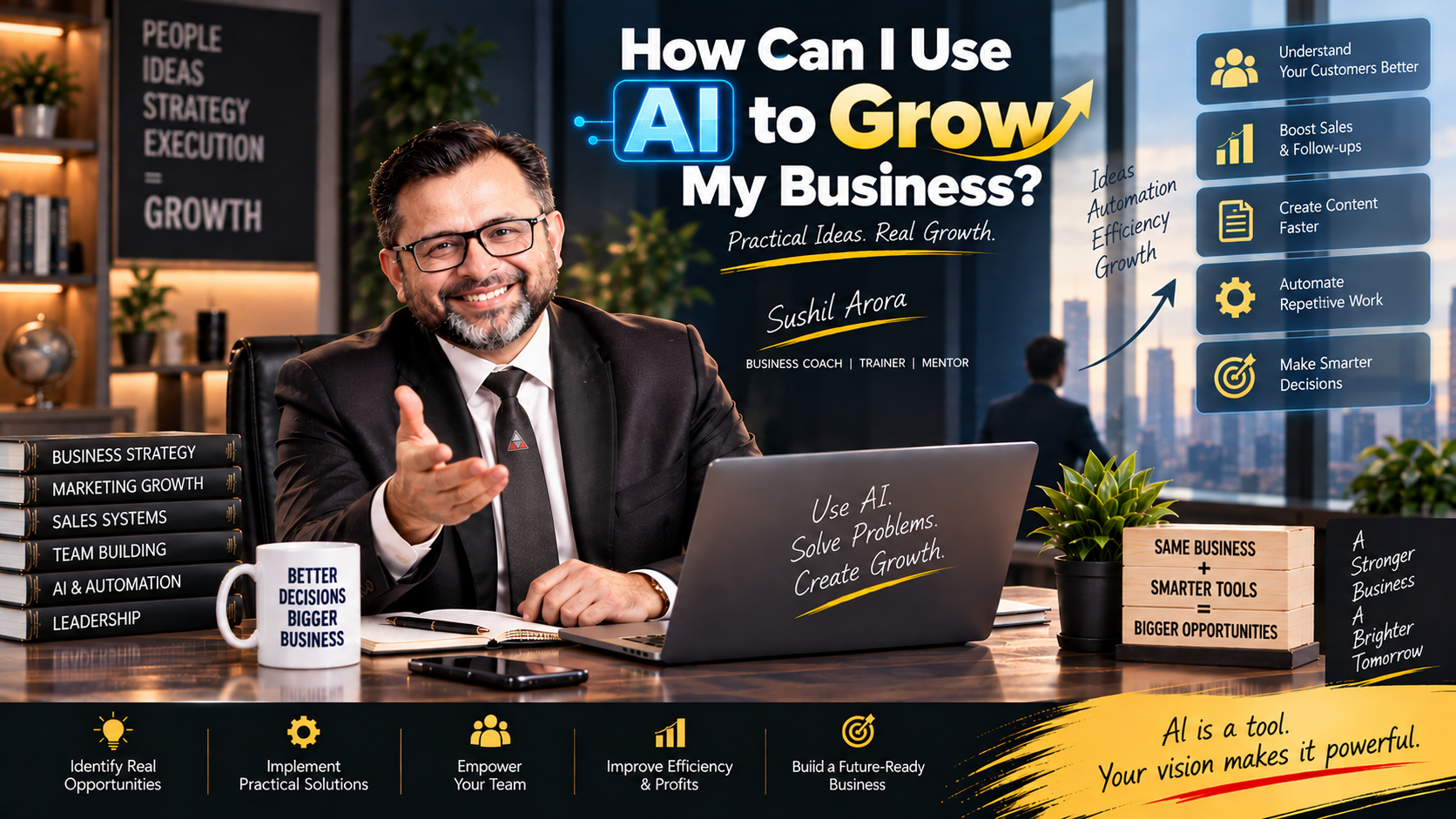
🤖 “Can AI Actually Help My Business Grow, or Is It Just Another Tool Everyone Is Talking About?”
This is a question I hear more often now.
Business owners are seeing AI everywhere.
AI for content.
AI for sales.
AI for customer service.
AI for reports.
AI for automation.
AI for data.
So the natural thought is:
“How Can I Use AI to Grow My Business?”
If you asked me this, I would not begin by listing tools.
I would begin with the business itself.
🎯 “Where Is My Business Losing Time, Customers, Money, or Opportunities Today?”
That is the question I want to answer first.
Because AI can help in many areas.
But if I do not know what problem I am trying to solve, I can easily add more software without improving the business.
💡 HOW I APPROACH AI-LED BUSINESS GROWTH — SUSHIL ARORA
🤖 When I work with a business owner who wants to use AI for growth, I first understand how the business currently gets customers, handles sales, serves people, manages information and spends the owner’s time.
🔍 Then I look for the biggest bottlenecks. I use AI where it can reduce repetitive work, improve visibility, support faster follow-up, organize information or help the team work more consistently. I do not want AI everywhere. I want it where it solves a real business problem.
🔍 AI Does Not Create Growth by Itself
This is important.
You can buy an AI tool today.
That does not mean sales will increase tomorrow.
You can create 100 AI-generated posts.
That does not mean customers will care.
You can automate emails.
That does not mean people will buy.
You can create dashboards.
That does not mean the business will make better decisions.
AI only becomes useful when it improves something that matters.
So I ask:
🎯 “What Should Be Better After I Use AI?”
Maybe:
Salespeople should respond faster.
Customers should get better follow-up.
The owner should spend less time on repetitive work.
Reports should become easier to understand.
Content should take less time to create.
Customer questions should be handled more consistently.
That gives AI a job.
💡 Do Not Use AI Because It Is Available. Use It Because You Know What Business Result You Want to Improve.
1. Use AI to Understand Your Customers Better
Business growth starts with customers.
So one of the first places I look is customer information.
Your business may already have useful information inside:
💬 Sales conversations
📧 Emails
📞 Customer calls
⭐ Reviews
❓ Support questions
📝 Feedback
📱 Messages
AI can help organize large amounts of this information and identify repeated themes.
For example:
What problems do customers mention most often?
What objections keep appearing?
What questions come before a sale?
What complaints are repeated?
Why do some customers leave?
🔍 “What Are My Customers Already Telling Me That I Have Not Organized Properly?”
That can lead to better sales, better content, better service, or even changes in the offer.
💡 AI Can Help You See Patterns. Your Team Still Needs to Decide What Those Patterns Mean for the Business.
2. Use AI to Help Your Sales Team Work Better
Salespeople often spend a surprising amount of time on work that is not really selling.
Writing follow-ups.
Updating CRM records.
Preparing notes.
Searching through old conversations.
Creating reports.
AI can help with some of this work.
For example:
🤖 Draft follow-up messages
📝 Summarize sales calls
📊 Organize sales notes
🔍 Help identify repeated objections
📋 Prepare meeting summaries
💬 Create first drafts for customer communication
Then the salesperson can spend more time talking to real prospects.
🎯 “What Is My Sales Team Doing Manually That AI Could Help Them Do Faster?”
That is where I would start.
But I would not let AI replace the human side of selling.
The salesperson still needs to listen.
Understand the customer.
Ask questions.
Build trust.
Make judgement calls.
🤝 AI Should Support the Sales Conversation, Not Replace the Relationship.
3. Use AI to Improve Lead Follow-Up
A business can spend money generating leads and still lose them because nobody follows up properly.
This is where AI and automation can help together.
A simple process might look like:
Lead Arrives → Assigned → First Contact → Follow-Up → Reminder → Next Action → Outcome
AI may help:
Draft a follow-up.
Summarize the last conversation.
Suggest the next action.
Organize the lead information.
Automation can help:
Create reminders.
Assign tasks.
Move the lead to the right person.
Alert a manager if follow-up is missed.
📞 “How Many Leads Are We Losing Because Our Follow-Up Process Depends on Memory?”
If the answer is many, this may be one of the first places I use AI.
4. Use AI to Create Better Content Faster
Content can help a business explain what it does.
But many owners do not have time to create content regularly.
AI can help with:
📝 Blog drafts
📱 Social posts
🎥 Video scripts
📧 Email drafts
❓ FAQs
♻️ Repurposing existing content
The important thing is where the ideas come from.
I would not ask AI:
“Give Me 100 Random Content Ideas.”
I would start with:
“What Questions Do My Customers Ask Me Every Week?”
Then I would turn those questions into useful content.
🧠 Your Experience Gives the Content Value. AI Helps You Turn That Experience Into More Formats.
5. Use AI to Reduce Repetitive Work
This can create real business value.
Think about tasks such as:
Preparing the same report every week.
Writing the same type of email.
Summarizing meetings.
Sorting customer enquiries.
Creating reminders.
Copying information.
Preparing routine internal updates.
I would ask:
⚙️ “Which Task Happens Repeatedly and Does Not Need Much New Thinking?”
That is where automation or AI may help.
But before automating, I would still ask:
“Should This Task Exist?”
If the task is unnecessary, remove it.
Do not automate waste.
💡 Remove → Simplify → Automate
That is the order I prefer.
6. Use AI to Help With Customer Service
Customer service teams answer many repeated questions.
“Where Is My Order?”
“How Does This Work?”
“What Happens After I Buy?”
“How Do I Change This?”
Some routine questions can be handled with AI-supported systems.
That can help customers get faster answers.
But I would keep human escalation clear.
If the customer is angry, confused, dealing with a special situation, or asking something sensitive, a person should be involved.
🤝 “Which Customer Questions Are Routine, and Which Need Human Judgement?”
That distinction is important.
🎯 Use AI to Improve response speed. Do Not Use It to Hide from difficult customer conversations.
7. Use AI to Help You Understand Business Data
Business owners often have data.
The problem is understanding it.
Sales reports.
Marketing reports.
Customer feedback.
Cash information.
Operational reports.
The owner may spend hours reading everything.
AI can help summarize information and highlight changes.
For example:
📊 What Changed in Sales This Month?
📉 Which Product Is Falling?
💰 Which Payments Are Overdue?
👥 Which Team Tasks Are Delayed?
🔍 What Customer Complaints Keep Appearing?
That can help the owner focus on what needs attention.
💡 AI Should Help You See the Important part faster, not make you dependent on more reports.
8. Use AI to Make Better Decisions, Not Automatic Decisions
AI can help compare information.
It can summarize options.
It can help identify patterns.
It can help you think through scenarios.
But I would not hand over important decisions blindly.
For example:
Should we hire more people?
Should we increase prices?
Should we enter a new market?
Should we stop a product?
Should we make a large investment?
These decisions need business context.
🎯 “What Can AI Help Me Understand Before I Decide?”
That is the better question.
🧠 Use AI for decision support. Keep responsibility for the decision with the right person.
9. Use AI to Help Manage Cash Flow
Cash flow can become stressful when owners do not know what is coming in and what is going out.
AI-supported systems can help organize information such as:
Expected collections.
Overdue invoices.
Upcoming payments.
Spending changes.
Cash trends.
Forecast scenarios.
Then the owner can ask:
💰 “Where Is Cash Likely to Become Tight?”
This does not make the forecast certain.
But it can help the owner see risk earlier.
🎯 AI Can Help You Spot a cash problem earlier. It cannot make the business financially disciplined for you.
10. Use AI to Improve Internal Knowledge
Many businesses depend too much on one person knowing everything.
An employee asks:
“How do we handle this?”
The owner explains.
Next week, another employee asks the same question.
This repeats.
I would turn repeated knowledge into something reusable.
SOPs.
Checklists.
Templates.
FAQs.
Internal guides.
AI can help organize and search that information where appropriate.
📚 “Which Questions Does My Team Keep Asking Me Again and Again?”
Those answers should not remain only in the owner’s head.
💡 Turn repeated knowledge into a system your team can use.
11. Use AI to Help Managers See Problems Earlier
A manager does not need every detail.
They need visibility.
Which leads are stuck?
Which customer issues are unresolved?
Which projects are delayed?
Which sales opportunities need attention?
Which employee tasks are overdue?
AI-supported systems may help summarize or flag unusual patterns.
Then the manager can investigate.
🔔 “What Needs My Attention Today?”
That is the kind of output I want.
Not more noise.
Better priorities.
12. Use AI to Help Your Small Team Do More
Small businesses cannot hire a separate team for every function.
That is where AI can be useful.
It may support parts of:
Marketing.
Sales.
Customer service.
Reporting.
Operations.
Administration.
But I would not think:
“AI Will Replace Five Employees.”
I would think:
🎯 “Which repetitive parts of these jobs can AI handle so people can spend more time on work that needs them?”
That is a healthier approach.
13. Protect Customer and Business Data
This part matters.
Businesses may put sensitive information into AI systems without thinking carefully.
Customer details.
Pricing.
Contracts.
Employee information.
Financial information.
Internal strategy.
Before using AI, understand how the tool handles data.
Who can access it?
What is stored?
What should never be shared?
What permissions are needed?
🔐 Convenience should not make you careless with business information.
14. Do Not Use AI Without Giving It Proper Context
This is one reason AI outputs often feel generic.
The business asks:
“Write a Sales Email.”
AI writes something generic.
Then the owner says:
“AI Doesn’t Understand My Business.”
Of course it does not.
You have not told it enough.
Give useful context.
Who is the customer?
What problem do they have?
What do you offer?
What happened in the last conversation?
What tone should be used?
What should not be claimed?
🤖 Better Context Usually Produces Better AI Support.
🚀 How I Would Introduce AI Into a Business
If you came to me and said:
“Sushil Sir, I Want to Use AI to Grow My Business. Where Do I Start?”
I would not introduce AI everywhere.
I would work through it like this.
🔍 Step 1: Find the Biggest Business Bottleneck
Maybe:
Lead conversion is weak.
Follow-up is poor.
Employees spend too much time on repetitive work.
Customer service is slow.
Content takes too long.
Reporting is messy.
Start with one real problem.
🗺️ Step 2: Map the Current Process
Write down what happens today.
Trigger → Action → Person → System → Result
Now we can see where work is slow or repetitive.
✂️ Step 3: Simplify Before Adding AI
Remove unnecessary steps.
Clarify responsibility.
Fix broken processes.
Then consider automation.
🤖 Step 4: Give AI One Clear Job
Maybe:
Summarize.
Draft.
Classify.
Organize.
Extract.
Compare.
Do not give AI a vague instruction like:
“Improve My Business.”
Give it a specific job inside a process.
👤 Step 5: Decide Where Human Review Is Needed
Routine work may run automatically.
Important customer, financial, people, legal, or strategic decisions may need human review.
Define this clearly.
🧪 Step 6: Test Small
Do not change the entire company in one day.
Use a small group.
One process.
One team.
See what breaks.
See what actually helps.
📊 Step 7: Measure the Before and After
Before AI:
How long did the work take?
How many tasks were missed?
How much manual effort was involved?
What was the result?
After AI:
🎯 “What Actually Improved?”
If the answer is nothing, stop or change the approach.
📈 Step 8: Expand What Works
If AI saves useful time or improves a measurable process, then I consider expanding it.
💡 Scale the AI use after the business value is clear, not before.
⚠️ The Mistake I Want Business Owners to Avoid
The biggest mistake is trying to become:
“An AI-Powered Business”
without becoming a better-run business.
You can automate:
Bad follow-up.
Bad customer service.
Bad processes.
Bad reports.
That does not make them good.
👉 Do Not Use AI to Hide a Business Problem. Use It After You Understand the Business Problem.
AI is a tool.
The process still matters.
The people still matter.
The customer still matters.
💡 HOW I LOOK AT AI-DRIVEN BUSINESS GROWTH — SUSHIL ARORA
🤖 When I use AI in a business, I am not trying to put technology into every department for the sake of it. I am looking for where the business is losing time, customers, money or visibility.
🔍 Then I choose a specific problem and decide whether AI can help. It may reduce repetitive work, help the team follow up better, organize information, support content, improve reporting or help managers see problems earlier.
🎯 The aim is not to make the company look more modern. The aim is to make the business easier to run and better at serving customers.
🧠 AI Should Give the Owner Time Back
This is one of the biggest reasons I find AI interesting for business.
Owners often spend time on:
Reports.
Messages.
Follow-ups.
Content.
Meeting notes.
Information searching.
Routine approvals.
Some of that can be reduced.
Then the owner can spend more time on:
Customers.
Team development.
Strategy.
Important decisions.
Growth opportunities.
🎯 “What Could I Do With Five Extra Hours a Week if AI Removed Repetitive Work?”
That is a useful question.
👥 Your Team Should Become Better With AI, Not More Dependent on It
I do not want employees copying every AI answer without thinking.
They still need judgement.
They still need skills.
They still need accountability.
AI should help them work.
Not become an excuse to stop understanding the work.
💡 A Strong employee using AI should become more effective, not less thoughtful.
📈 Growth Should Still Make Business Sense
AI may help you:
Produce more content.
Reach more leads.
Respond faster.
Handle more enquiries.
Fine.
But does it improve:
Customers?
Sales?
Retention?
Margins?
Productivity?
Owner time?
If not, why are we doing it?
📊 AI activity is not the same as business growth.
That distinction matters.
💬 Final Thoughts From Sushil Arora
If you are asking:
“How Can I Use AI to Grow My Business?”
do not begin with a list of AI tools.
Begin with your business.
🔍 Where Are We Losing Opportunities?
⏱️ Where Is the Team Wasting Time?
📞 Where Are Follow-Ups Being Missed?
👥 Where Are Customers Waiting Too Long?
📊 Where Do We Have Data but not enough understanding?
🤖 Which repetitive work can AI help reduce?
🧠 Where does human judgement still matter?
💰 What result should improve if we use AI?
Then introduce AI one problem at a time.
Do not add AI before understanding the process.
Do not automate bad work.
Do not publish or send AI output blindly.
Do not give AI important decisions without proper human review.
Do not measure success by how many AI tools you use.
🎯 Your Next Step
Take one week and notice where your business repeatedly loses time or opportunities.
Write down:
👉 Which Task Takes Too Long?
👉 Which Work Happens Again and Again?
👉 Which Customer Question Repeats Most Often?
👉 Which Follow-Up Is Most Often Missed?
👉 Which Report Takes Too Much Time to Prepare?
👉 Which Information Is Hard to Find?
👉 Which Decision Needs Better Data?
Then choose one problem.
Ask:
🎯 “Can AI Help Me Solve This Specific Problem Better, Faster or More Consistently?”
If yes, test it.
Give AI a clear role.
Keep the right people involved.
Measure what changes.
Then move to the next opportunity.
💡 MY AI BUSINESS-GROWTH PHILOSOPHY — SUSHIL ARORA
🤖 I do not believe AI grows a business simply because the business starts using it. Growth happens when AI improves a process that matters.
🔍 My approach is to find the business bottleneck first, improve the process, give AI a specific job, keep human judgement where it is needed and measure whether the result actually gets better.
🎯 For me, the best use of AI is simple: less repetitive work, better information, faster execution and more time for people to focus on customers, decisions and growth.
— Sushil Arora
2 thoughts on “How Can I Use AI to Grow My Business?”