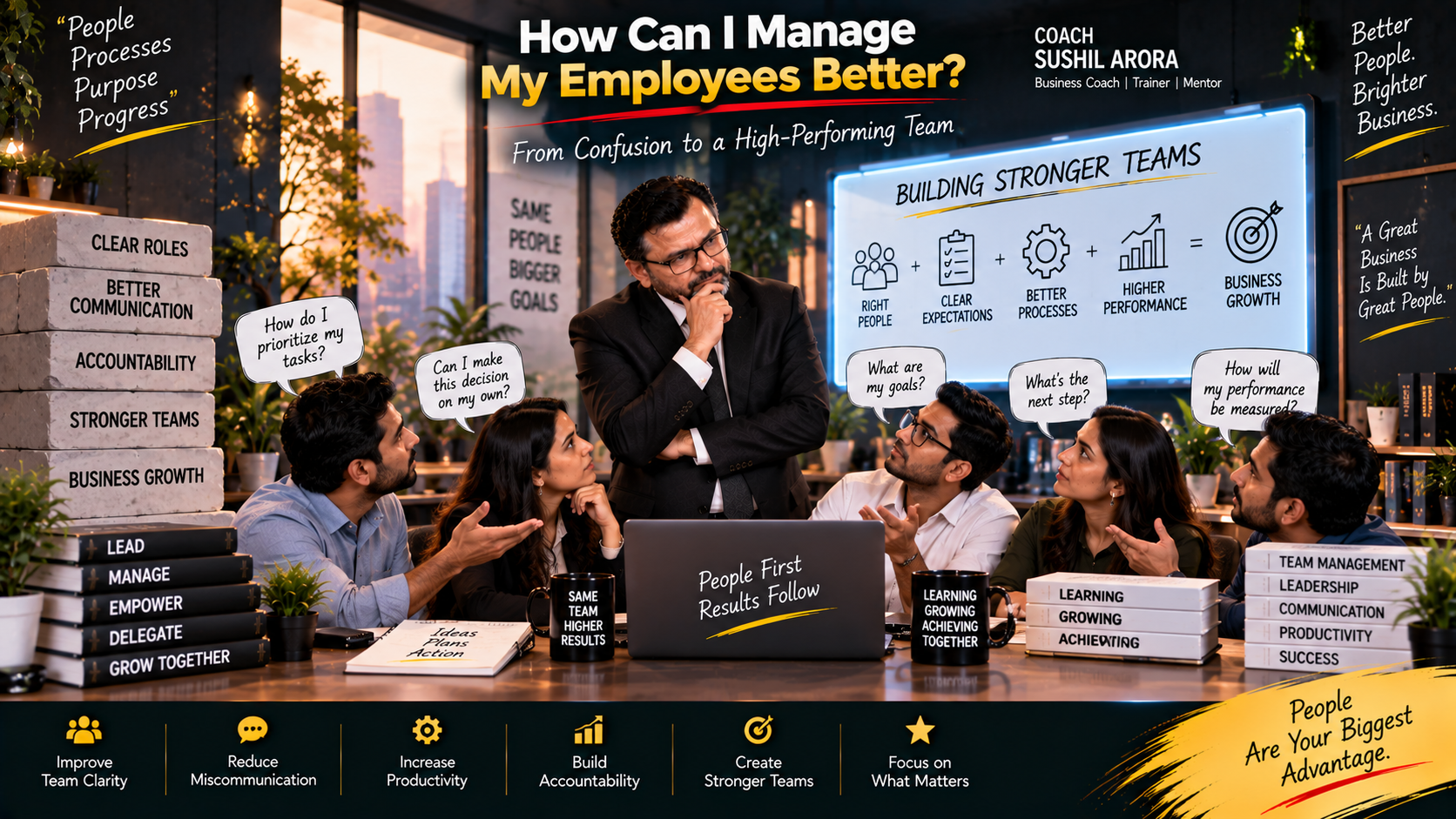
👥 “Why Does Managing My Team Take So Much of My Time?”
As a business grows, managing employees can become one of the owner’s biggest daily responsibilities.
In the beginning, it feels manageable.
You have a small team. Everyone sits close to you. If something needs to be done, you tell the person directly.
Then the team grows.
More people join.
More customers arrive.
More work moves between departments.
And suddenly, your day starts sounding like this:
“Has this been completed?”
“Who is handling that customer?”
“Why wasn’t I informed?”
“I already explained this yesterday.”
“Why does everyone keep coming to me for decisions?”
Eventually, the owner asks:
“How Can I Manage My Employees Better Without Constantly Chasing Everyone?”
If you asked me this, I wouldn’t start by telling you to become stricter.
I would ask:
🎯 “Does Your Team Have Enough Clarity to Work Properly Without Depending on You for Every Small Thing?”
Because better employee management doesn’t mean watching people more closely.
It means creating a working environment where people understand what they own, what result is expected, what they can decide, and how their work will be reviewed.
💡 HOW I APPROACH TEAM MANAGEMENT — SUSHIL ARORA
👥 When I work with a business owner who feels exhausted managing employees, I don’t simply tell them to push the team harder. I first look at how work is assigned, how priorities are communicated, where decisions get stuck, and how performance is reviewed.
🎯 My aim is to reduce confusion between the owner and the team. I want employees to know what they are responsible for and owners to manage through clear results instead of spending the entire day following people around for updates.
🔍 First, I Would Find Out Why You Have to Manage So Much
Suppose you have 20 employees.
Every day, 15 of them come to you with questions.
At first, you may think:
“My Employees Can’t Make Decisions.”
But I would look deeper.
What are they asking?
Are they asking because they genuinely need your judgement?
Or because nobody has told them what they are allowed to decide?
Are they asking questions that could have been answered by a process?
Are managers sending everything upward because their authority isn’t clear?
Are employees coming to you because responsibilities overlap?
👉 “Why Does This Decision Need to Reach the Owner?”
I would start recording the types of questions reaching you.
You may discover that the same issues appear again and again.
That’s useful.
Because repeated questions often point toward something that can be clarified or systemized.
💡 If Your Team Keeps Asking You the Same Question, Don’t Just Keep Answering It. Ask Why the Question Keeps Reaching You.
1. Give Every Employee a Clear Role
I don’t want an employee’s job description to be something vague like:
“Handle operations.”
What does that actually mean?
Instead, I want clarity.
What does this person own?
What results are expected?
What are their regular responsibilities?
Who do they report to?
Which decisions can they make?
What must they escalate?
📋 “What Is This Person Actually Responsible For?”
Every employee should be able to answer that.
And the manager should give roughly the same answer.
If the employee thinks they own one thing and the manager expects something else, frustration is almost guaranteed.
🎯 Better Management Starts With Clear Responsibility.
2. Stop Managing Everything Through Verbal Instructions
This is one of the first changes I would make in a growing business.
Imagine the owner walking into the office:
“Rahul, send that proposal.”
Ten minutes later:
“Priya, call that customer.”
Then:
“Someone remind me about the supplier.”
Then a WhatsApp message:
“Please finish this today.”
By evening, everyone has received instructions from different places.
Now ask:
“Where Can I See Everything That Needs to Be Done?”
If the answer is inside the owner’s head, we have a problem.
For important work, I want a simple structure:
Task → Owner → Deadline → Priority → Status → Result
This could be managed through an appropriate task-management system, CRM, project tool, or another method that fits the business.
The tool matters less than the discipline.
⚙️ Don’t Make Your Memory the Company’s Task-Management System.
3. Tell Employees What Result You Want, Not Just What Activity to Do
Owners sometimes manage activity.
“Make 50 calls.”
“Send 100 messages.”
“Visit ten customers.”
“Post every day.”
Activity can be useful.
But I also want to know what result we’re trying to create.
Suppose a salesperson makes 100 calls but creates no meaningful opportunities.
Was that a productive day?
Maybe. Maybe not.
I would connect activity with outcome.
📞 Calls → Conversations → Qualified Opportunities → Follow-Ups → Customers
Now we can understand what is happening.
🎯 “What Result Is This Employee Responsible for Producing?”
That is one of the most useful management questions I know.
4. Set Priorities Before the Day Becomes Chaotic
Employees often have more work than they can finish immediately.
That’s normal.
The problem starts when nobody knows what comes first.
A customer issue arrives.
A report is due.
The owner asks for something.
Another department needs help.
An urgent WhatsApp message appears.
Everything becomes:
“Do This First.”
Then five minutes later:
“No, This Is More Important.”
I would create clearer priorities.
What matters this week?
What must happen today?
What can wait?
What is genuinely urgent?
🎯 “If My Employee Can Complete Only Three Important Things Today, Which Three Should They Be?”
That creates focus.
💡 Employees Work Better When Priorities Stay Clear Long Enough for Them to Finish Something.
5. Delegate the Decision Along With the Task
This is where many owners accidentally become bottlenecks.
They delegate work but keep every decision.
For example:
“Handle this customer complaint.”
The employee asks:
“Can I offer a replacement?”
Owner approval required.
“Can I waive this small charge?”
Owner approval required.
“Can I change the delivery date?”
Owner approval required.
Eventually, the employee learns:
“Don’t Decide Anything. Ask the Owner.”
Then the owner says:
“Why Can’t My Team Handle Anything Without Me?”
This is exactly what I would fix.
For each role, I want to define:
🔑 What Can You Decide Yourself?
🔑 What Requires Manager Approval?
🔑 What Must Come to the Owner?
🔑 When Should You Escalate Immediately?
Employees need boundaries.
💡 Delegation Without Decision-Making Authority Often Becomes Task Distribution, Not Real Ownership.
6. Don’t Solve Every Problem for Your Employees
An employee comes to you and says:
“Sir, we have a problem.”
The easiest thing is to give the answer.
But if you do that every time, the employee learns to bring problems instead of thinking through them.
Sometimes I would respond with:
👉 “What Do You Think We Should Do?”
Or:
👉 “Give Me Two Possible Solutions.”
Now the employee has to think.
You can still guide the final decision.
But over time, you’re helping the person develop judgement.
🧠 If You Always Provide the Answer, Don’t Be Surprised When Your Team Keeps Coming Back for Answers.
7. Build Simple Processes for Repeated Work
If your team performs the same activity repeatedly, I don’t want the quality depending entirely on who happens to do it.
For example:
New customer onboarding.
Lead follow-up.
Complaint handling.
Order processing.
Payment collection.
Daily closing.
Quality checks.
These can often benefit from a clear process.
⚙️ Trigger → Steps → Responsibility → Check → Completion
The process doesn’t have to become complicated.
A checklist may be enough.
A template may be enough.
A short SOP may be enough.
🎯 “What Work Are We Doing Repeatedly That Still Depends on Someone Remembering Every Step?”
That’s where I would begin documenting.
8. Hold Fewer Meetings, but Make Them Useful
Another management problem appears when every issue becomes a meeting.
Morning meeting.
Department meeting.
Review meeting.
Follow-up meeting.
Then employees complain they don’t have time to finish the work discussed in all those meetings.
I prefer meetings with a clear purpose.
A useful team review might answer:
What Was Supposed to Happen?
What Actually Happened?
What’s Stuck?
Who Owns the Next Action?
When Will It Be Done?
Then move on.
⏱️ A Meeting Should Help Work Move Forward. It Shouldn’t Become a Substitute for Work.
9. Give Feedback While It Can Still Help
Don’t wait six months to tell an employee:
“You’ve Been Doing This Wrong for Months.”
If something needs correcting, discuss it while the situation is still fresh.
And be specific.
Instead of:
“Your attitude isn’t good.”
Explain the behaviour you’re concerned about.
Instead of:
“Your customer handling is poor.”
Explain what happened.
💬 “Three customer enquiries were left without follow-up this week. Let’s understand why.”
Now you have something concrete to work with.
The same applies to good work.
If someone handled a difficult situation well, tell them what they did well.
🎯 Useful Feedback Gives an Employee Something Specific to Continue or Change.
10. Measure Performance Without Watching Every Move
Some owners think better management means more monitoring.
Every login.
Every minute.
Every call.
Every movement.
I don’t think that’s a healthy default.
I would rather define a few meaningful measures for the role.
For a salesperson, those measures may relate to qualified opportunities, conversion, follow-up, revenue, or another relevant result.
For customer service, they may involve response, resolution, quality, or customer outcomes.
For operations, they may involve completion, errors, turnaround times, or quality.
The exact measure depends on the job.
📊 “What Numbers or Results Tell Me Whether This Role Is Working Well?”
Choose those.
Then review them consistently.
💡 Manage Results Where Possible. Don’t Turn Management Into Constant Surveillance.
11. Don’t Manage Every Employee in Exactly the Same Way
A new employee may need more guidance.
An experienced employee who consistently performs well may need more independence.
Someone learning a new responsibility may need frequent feedback.
A strong manager shouldn’t need the owner checking every task.
I would adjust the level of supervision based on:
Skill.
Experience.
Performance.
Risk of the decision.
Complexity of the work.
👥 “How Much Support Does This Person Need Right Now?”
That is more useful than treating everyone identically.
As competence increases, independence should usually increase too.
12. Build Managers Before the Team Becomes Too Large
As the business grows, the owner cannot realistically manage everyone directly.
Imagine 50 employees all reporting to one person.
Every leave request.
Every disagreement.
Every customer issue.
Every target.
Every approval.
Everything reaches the owner.
That’s not scalable.
At some point, I would look at the management structure.
Who can lead a team?
Who can review performance?
Who can make decisions?
Who can coach employees?
Who can take responsibility for a department?
📈 “Am I Building Managers, or Am I Simply Adding More People Who Eventually Report to Me?”
That’s an important growth question.
13. Don’t Ignore Good Employees While Managing Poor Performance
This happens more often than owners realise.
One difficult employee takes 80% of the manager’s attention.
Meanwhile, the people doing good work hear very little.
Their work becomes expected.
Mistakes get attention.
Consistency doesn’t.
I would make sure managers also notice good performance.
Not with empty praise.
Be specific.
🤝 “You Handled That Customer Problem Without needing escalation and kept the customer informed throughout. That’s exactly the ownership we need.”
Now the employee understands what behaviour the business values.
💡 Don’t Let Your Best Employees Become Invisible Simply Because They Create Fewer Problems.
🚀 How I Would Help a Business Owner Manage Employees Better
If you came to me and said:
“Sushil Sir, I Spend My Entire Day Managing People. How Would You Fix This?”
I wouldn’t start with motivational training.
I would look at how work moves through the company.
🔍 Step 1: Map Who Is Responsible for What
I would look at the team structure.
Who owns sales?
Who owns operations?
Who owns customer service?
Who owns collections?
Who owns important recurring tasks?
Where is responsibility unclear?
📋 Step 2: Define the Expected Results
For each important role:
Role → Responsibility → Expected Result → Authority → Measure
Now both manager and employee have a clearer understanding.
⚙️ Step 3: Move Repeated Instructions Into Processes
If the owner explains the same task repeatedly, I would ask whether it needs a checklist, template, SOP, system, or training material.
🔑 Step 4: Define Decision Boundaries
What can employees decide?
What can managers decide?
What genuinely needs the owner?
This is where we start reducing unnecessary owner dependence.
🎯 Step 5: Create Clear Weekly Priorities
I don’t want employees receiving ten changing priorities from different people.
The team should know what matters.
📊 Step 6: Build a Simple Review Rhythm
Depending on the role, I would create practical reviews.
What was committed?
What was completed?
What missed?
Why?
What’s next?
No unnecessary drama.
Just visibility and accountability.
💬 Step 7: Improve Feedback and Coaching
If someone lacks skill, train them.
If expectations aren’t clear, clarify them.
If the process is broken, fix it.
If performance repeatedly remains poor after reasonable support, deal with the performance issue directly.
👥 Step 8: Develop Team Leaders
As the business grows, I want capable people between the owner and every individual employee.
Otherwise, the owner becomes the management system.
📈 Step 9: Measure Whether Owner Dependence Is Falling
This is something I would actively watch.
Ask:
“How Many Decisions Reached Me This Month That Someone Else Could Have Handled?”
If that number gradually falls while work quality remains healthy, we’re moving in the right direction.
⚠️ The Mistake I Want Business Owners to Avoid
There are two extremes.
One owner controls everything.
Another says:
“I’ve hired good people. They should figure it out.”
Neither approach works particularly well.
Employees need clarity.
They need reasonable authority.
They need accountability.
They need feedback.
And sometimes they need help.
👉 Good Management Isn’t Doing Everything for Your Employees, and It Isn’t Leaving Them to Guess.
The owner creates the structure.
The employee works within that structure and takes responsibility for their role.
💡 HOW I LOOK AT EMPLOYEE MANAGEMENT — SUSHIL ARORA
👥 When I work with a business owner who feels trapped in daily employee management, I look for where the dependence is coming from. Are responsibilities unclear? Are decisions concentrated with the owner? Are processes missing? Are priorities constantly changing? Is accountability weak?
🎯 Then I work on those specific points. I define ownership, clarify authority, build simple processes, create a review rhythm and help managers focus on results rather than chasing employees throughout the day.
For me, the real test isn’t:
“How Hard Is the Owner Managing?”
The better question is:
“How Well Can the Team Work When the Owner Isn’t Standing Beside Them?”
🧠 Your Business Shouldn’t Need You in Every Conversation
There is something I want owners to notice.
Being needed can feel good.
The team asks you.
You solve it.
Customers ask for you.
You handle it.
Managers get stuck.
You decide.
You feel important because you’re involved everywhere.
But eventually that becomes exhausting.
And it limits the business.
🎯 “Am I Helping My Team Become Better, or Am I Training Them to Depend on Me?”
That question can be uncomfortable.
But it matters.
The goal isn’t to make yourself unnecessary to your business.
The goal is to make sure your time is being used where your judgement genuinely adds value.
💡 If the Owner Is Making Every Small Decision, Who Is Spending Time Thinking About Where the Business Goes Next?
🤝 Management Is Also About Listening
Better employee management isn’t only about giving instructions.
Sometimes the people doing the work see problems before the owner does.
A salesperson may notice a repeated customer objection.
An operations employee may know which process wastes hours.
A customer-service employee may hear the same complaint every week.
A manager may know why a deadline keeps slipping.
Ask them.
💬 “What Is Making Your Job Harder Than It Needs to Be?”
You may discover a process problem that no dashboard was showing you.
Listening doesn’t mean agreeing with every suggestion.
It means making sure useful information can move upward as well as instructions move downward.
💬 Final Thoughts From Sushil Arora
If you’re asking:
“How Can I Manage My Employees Better?”
Don’t begin by trying to control more.
Start by creating more clarity.
📋 Does Every Employee Know What They Own?
🎯 Do They Know What Result Is Expected?
🔑 Do They Know What They Can Decide?
⚙️ Are Repeated Tasks Supported by Clear Processes?
📌 Are Priorities Clear?
📊 Is Performance Reviewed Consistently?
💬 Are Employees Getting Useful Feedback?
👥 Are Managers Actually Managing?
🧠 Are Employees Learning to solve appropriate problems without immediately coming to you?
🤝 Are You Listening to What the Team Is seeing?
Better management doesn’t mean becoming more involved in every task.
In many cases, it means creating a business that requires less unnecessary involvement from you.
🎯 Your Next Step
For the next week, notice every time an employee comes to you for a routine decision.
Write down the question.
Then ask:
👉 Why Did This Need Me?
👉 Was Responsibility Unclear?
👉 Was Authority Unclear?
👉 Was There No Process?
👉 Was the Employee Missing a Skill?
👉 Could a Manager Have Handled It?
👉 Have I Answered This Same Question Before?
At the end of the week, look for patterns.
Then ask yourself:
🎯 “Which Decisions Am I Still Making That My Team Should Be Capable of Handling Without Me?”
Start with one.
Clarify responsibility.
Define the boundaries.
Give the person the information they need.
Let them handle it.
Review the result.
Then move to the next one.
That’s how I would gradually reduce unnecessary dependence on the owner without losing control of the business.
💡 MY EMPLOYEE-MANAGEMENT PHILOSOPHY — SUSHIL ARORA
👥 I don’t believe good employee management means constantly checking whether people are working. I want employees to understand their responsibilities, know what result is expected, have appropriate authority and be accountable for what they own.
⚙️ My approach is to move repeated work into clear processes, move appropriate decisions away from the owner, build capable managers and review performance through useful results rather than constant chasing.
🎯 When that starts happening, the owner gets time back, employees develop more responsibility, and the business becomes less dependent on one person to keep every task moving.
— Coach Sushil Arora