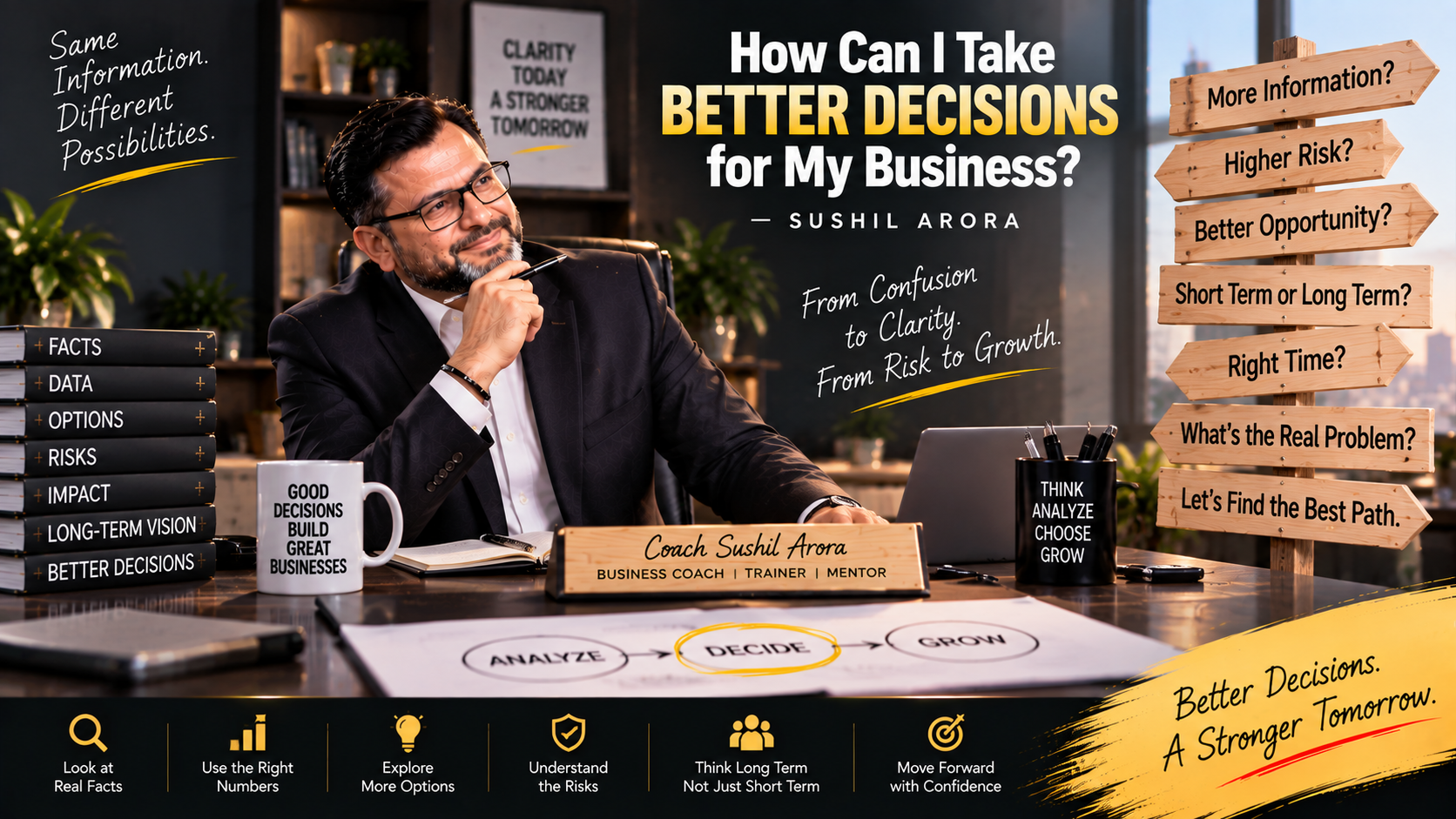
🤔 “How Do I Know Whether I’m Making the Right Decision for My Business?”
Every business owner makes decisions.
Some are small.
Should I approve this expense?
Should I give this customer a discount?
Should we change this process?
Others can affect the direction of the business.
Should I hire more people?
Should I launch a new product?
Should I increase prices?
Should I enter a new market?
Should I invest more money in marketing?
The difficult part is that you rarely have perfect information.
You make a decision today and see the real result weeks or months later.
That is why business owners sometimes ask me:
“Sushil Sir, How Can I Take Better Decisions for My Business?”
My first answer is simple.
Don’t try to become someone who never makes a wrong decision.
Build a better decision-making process.
I would start by asking:
🎯 “What Information Do I Need Before I Can Make This Decision Properly?”
That one question can prevent many rushed decisions.
💡 HOW I APPROACH BUSINESS DECISIONS — SUSHIL ARORA
🧠 When I work with a business owner facing an important decision, I don’t begin by telling them what I would do. I first understand the problem, the numbers, the available options, the risks and what result the owner is actually trying to achieve.
🎯 Then I help them separate facts from assumptions and emotion. My role is to make the decision clearer, because I believe an owner should understand why a decision makes sense instead of simply following someone else’s opinion.
🔍 First, Make Sure You Are Solving the Right Problem
Suppose sales are falling.
The immediate decision might be:
“We Need to Spend More on Advertising.”
But wait.
Why are sales falling?
Are fewer leads coming in?
Are leads coming in but not converting?
Are existing customers buying less?
Has the market changed?
Is pricing causing a problem?
Is the sales team following up properly?
These are very different situations.
If the real problem is poor lead conversion, increasing advertising may simply give you more leads to lose.
💡 A Good Decision Starts With a Clear Problem.
Before deciding anything important, I ask:
🎯 “What Exactly Are We Trying to Fix?”
1. Separate Facts From Assumptions
Owners know their businesses well.
But experience can sometimes make assumptions feel like facts.
You may say:
“Customers Think Our Price Is Too High.”
How do you know?
Did customers tell you?
Did conversion fall after a price increase?
Did your salespeople record price as the reason deals were lost?
Or does it simply feel like the most likely explanation?
I like separating information into two columns:
✅ What Do We Know?
and
❓ What Do We Think?
For example:
Fact: Sales declined last month.
Assumption: Customers are buying from a cheaper competitor.
Those are not the same thing.
🧠 “What Evidence Supports What I Currently Believe?”
That question can change the entire decision.
2. Look at the Numbers That Actually Matter
I don’t believe every business owner needs 50 dashboards.
Too much data can create another problem.
I want the numbers connected to the decision.
If you’re deciding whether to increase marketing spend, I may look at:
Lead volume.
Lead quality.
Conversion.
Customer acquisition cost where available.
Revenue generated from relevant campaigns.
If you’re deciding whether to hire, I may look at:
Current workload.
Capacity.
Cost of the hire.
Expected contribution.
Cash position.
If you’re considering a new product, the information will be different.
📊 “Which Numbers Would Help Me Make This Specific Decision?”
That is more useful than collecting data simply because software can display it.
3. Don’t Make Permanent Decisions Because of Temporary Problems
One bad week can feel much bigger when you are inside the business.
Sales drop.
A customer leaves.
An employee makes a mistake.
A campaign performs poorly.
The immediate reaction may be:
“We Need to Change Everything.”
I would slow that decision down where circumstances allow.
Ask:
🔍 “Is This a Pattern or a One-Time Event?”
If sales have fallen for one week, understand why.
If sales have been falling for six months, that tells us something different.
🎯 Look for Patterns Before Making Large Changes Based on Short-Term Noise.
Of course, some situations genuinely require immediate action.
But many do not.
4. Define What a Good Result Looks Like Before You Decide
Suppose you are considering hiring another salesperson.
What is the purpose?
More revenue?
Faster lead response?
Entering another territory?
Reducing pressure on the existing team?
Without a clear result, it becomes difficult to judge the decision later.
So before making the decision, I ask:
🎯 “What Should Be Different if This Decision Works?”
Maybe:
Lead response should fall below a certain time.
The team should handle more opportunities.
A manager should spend fewer hours on routine sales work.
Now we have something to review later.
💡 If You Don’t Define Success Before the Decision, It Becomes Easy to Justify Almost Any Result Afterwards.
5. Create More Than One Option
Owners sometimes trap themselves between:
“Do It”
and
“Don’t Do It.”
But there may be another option.
Suppose you are considering opening another location.
Your choices may include:
Open immediately.
Don’t open.
Test the market first.
Use a temporary location.
Partner with someone.
Expand the existing location instead.
I like asking:
🧠 “What Other Reasonable Option Am I Ignoring?”
A third option can sometimes be better than either of the obvious choices.
6. Think About the Downside Before You Think About the Upside
Business owners naturally look at opportunity.
“If this works, we could grow sales by a lot.”
Fine.
Now I ask:
⚠️ “What Happens if It Doesn’t Work?”
How much money could you lose?
How much time?
Would it damage customer relationships?
Would it distract the team?
Would it create cash pressure?
Can the decision be reversed?
🎯 “Can My Business Handle the Downside?”
I don’t ask this to avoid risk.
Business involves risk.
I ask it so the owner understands the risk being taken.
7. Know Whether the Decision Is Reversible
This is one distinction I find useful.
Some decisions are relatively easy to reverse.
You test a new advertisement.
It doesn’t work.
You stop it.
You try a new internal reporting format.
The team dislikes it.
You change it.
Other decisions are harder to reverse.
Signing a long lease.
Making a large investment.
Taking significant debt.
Changing a major supplier.
Entering a long-term agreement.
I would spend more time on decisions that are expensive or difficult to reverse.
💡 Don’t Give Every Decision the Same Amount of Time.
A small reversible decision should not take three weeks.
A major difficult-to-reverse decision should not be made in three minutes.
8. Ask the People Who Are Closest to the Problem
Owners do not always have the complete picture.
Suppose customer complaints are increasing.
Before changing the product, I might speak to:
Customer service.
Sales.
Operations.
And, where appropriate, customers.
The employee speaking with customers every day may know something the owner does not.
👥 “What Are You Seeing That I May Be Missing?”
That is a question I like asking teams.
But getting input does not mean the owner has to follow every opinion.
The purpose is to see the problem from more than one angle.
🎯 Listen Widely. Then Decide Clearly.
9. Don’t Let the Loudest Person Make the Decision
A confident employee is not automatically correct.
An angry customer does not necessarily represent all customers.
One salesperson’s opinion may not represent the whole market.
One successful month does not prove a strategy will always work.
I want evidence.
🔍 “Is This an Individual Opinion, or Do We See the Same Pattern Elsewhere?”
That helps prevent the business from changing direction every time someone speaks strongly.
10. Avoid Making Important Decisions When You Are Reacting Emotionally
Business decisions can become personal.
A customer criticizes you.
An employee resigns.
A competitor launches something similar.
Sales suddenly fall.
You may feel pressure to respond immediately.
Sometimes you genuinely need to.
But when you don’t, give yourself enough time to understand what happened.
🧠 “Am I Solving the Business Problem, or Am I Reacting to How This Situation Made Me Feel?”
That can be an uncomfortable question.
But it is useful.
💡 Emotion Gives You Information. It Shouldn’t Automatically Make the Decision.
11. Use AI to Help You Analyse, Not to Hand Over the Decision
AI can help business owners work through information.
For example, it may help:
🤖 Summarize reports.
📊 Organize business data.
📝 Compare options.
🔍 Identify patterns in customer feedback.
💬 Summarize meeting notes.
❓ Generate questions you may not have considered.
It can be useful as a thinking aid.
But I would not type:
“AI, Should I Invest ₹20 Lakh in This Business Expansion?”
and blindly follow the answer.
AI does not automatically know everything about your business.
It may have incomplete information.
It may make incorrect assumptions.
It can also produce incorrect information.
🎯 Use AI to Improve the Information Around the Decision. Keep Responsibility for the Decision With the Right Person.
12. Stop Making the Same Decision Again and Again
Some owners repeatedly answer the same questions.
“Can We Give This Discount?”
“Can We Approve This Refund?”
“Can We Buy This?”
“Can We Extend This Deadline?”
Instead of deciding each case from zero, create rules where appropriate.
For example:
Employees can decide within one limit.
Managers can decide within another.
Exceptions reach the owner.
⚙️ Repeated Decision → Clear Rule → Appropriate Authority
Now the owner has fewer routine decisions to make.
💡 If You Have Made the Same Type of Decision 50 Times, Ask Whether It Still Needs to Be a Decision.
Maybe it needs to become a policy.
13. Record Important Decisions
This is something I encourage for larger decisions.
Write down:
What Are We Deciding?
Why Are We Deciding It?
What Information Did We Use?
What Are We Assuming?
What Result Do We Expect?
When Will We Review It?
Why?
Because memory changes.
Six months later, people often say:
“We always knew this would happen.”
Did we?
A simple decision record shows what we actually believed at the time.
📝 Judge the Quality of the Decision Based on the Information Available Then, Not Only on What You Know Afterwards.
14. Review Your Decisions Instead of Just Moving On
Suppose you increased your marketing budget three months ago.
What happened?
Don’t simply move on to the next decision.
Review it.
📊 What Did We Expect?
What Actually Happened?
What Did We Get Right?
What Did We Miss?
What Would We Do Differently?
This is how decision-making improves.
🎯 Experience Helps Only if You Learn From It.
🚀 How I Would Help a Business Owner Make a Difficult Decision
If you came to me and said:
“Sushil Sir, I Have a Big Business Decision to Make. How Would You Approach It?”
I would work through it in this order.
🔍 Step 1: Define the Decision Clearly
Not:
“Business Is Slow. What Should I Do?”
Instead:
“Should We Increase Marketing Spend to Generate More Qualified Leads?”
Now we have something specific.
📊 Step 2: Collect the Relevant Information
What numbers matter?
What customer information matters?
What does the team know?
What information is missing?
I don’t want endless research.
I want enough useful information to make a reasonable decision.
🧠 Step 3: Separate Facts From Assumptions
Write them separately.
This helps expose what still needs checking.
🔀 Step 4: Create Real Options
I would normally avoid treating every decision as yes or no.
What alternatives exist?
Can we test something first?
Can we reduce the size of the commitment?
Can we delay part of it?
⚠️ Step 5: Understand the Risk
Ask:
What Could Go Wrong?
How Serious Would It Be?
Can We Recover?
Can We Reduce the Risk Before Acting?
🧪 Step 6: Test Before Committing Where Possible
Suppose you are considering a major new service.
Can you test demand with a smaller group?
Suppose you want to increase advertising significantly.
Can you test the approach with a smaller budget first?
💡 A Small Test Can Turn an Expensive Guess Into Useful Information.
🎯 Step 7: Decide Who Owns the Decision
Sometimes too many people are involved.
Everyone gives an opinion.
Nobody decides.
I want clarity.
Who provides input?
Who makes the final decision?
Who implements it?
Who measures the result?
📅 Step 8: Set a Review Date
Don’t keep reconsidering the decision every morning.
Decide.
Act.
Then review it at an appropriate point.
“We Will Review This After 30 Days.”
or:
“We Will Review This After We Have Enough Results to Judge It.”
📈 Step 9: Learn From the Outcome
Whatever happens, capture the lesson.
That helps improve the next decision.
⚠️ The Mistake I Want Business Owners to Avoid
One mistake is waiting for complete certainty.
You may think:
“I Will Decide When I Am 100% Sure.”
In business, that moment may never arrive.
You will often have incomplete information.
The answer is not to guess blindly.
It is to gather enough relevant information, understand the risk, choose a reasonable option and act.
👉 Good Decision-Making Does Not Mean Knowing the Future. It Means Making a Reasoned Choice With the Information You Have and Being Ready to Adjust When New Information Appears.
💡 HOW I LOOK AT BUSINESS DECISION-MAKING — SUSHIL ARORA
🧠 When a business owner asks me what they should do, I don’t want them to become dependent on my answer. I want them to understand the thinking behind the decision.
🔍 I help them define the real problem, look at the relevant numbers, challenge assumptions, compare options and understand the downside. Where possible, I prefer testing an idea before making a large commitment.
🎯 My aim is to help owners build a repeatable way of thinking, so better decision-making becomes part of how they run the business rather than something they need only when a crisis appears.
🧠 A Good Decision Can Still Have a Bad Outcome
This is important.
Suppose you carefully evaluate a new product.
Customer research looks positive.
The numbers make sense.
You run a reasonable test.
You launch.
Then market conditions change and the product performs poorly.
Was the decision automatically bad?
No.
A sensible decision can sometimes produce a poor outcome.
And a careless decision can occasionally produce a good outcome.
That is why I separate:
Decision Quality
from:
Outcome
💡 Don’t Judge Every Decision Only by Whether You Won or Lost. Ask Whether the Process Was Sensible.
That is how owners improve over time.
📊 Better Information Should Make Decisions Easier, Not Slower
There is another trap.
You keep asking for more reports.
More research.
More opinions.
More analysis.
Eventually:
“I Need More Information Before I Decide.”
becomes a way of avoiding the decision.
I would ask:
🎯 “What Additional Information Could Realistically Change My Choice?”
If the answer is none, you may already know enough.
Make the decision.
👥 Your Team Should Be Able to Make Better Decisions Too
I don’t want all good decision-making sitting with the owner.
Managers should know how to think through problems.
Employees should know which decisions they can make.
Teams should understand the numbers relevant to their work.
So instead of always answering:
“What Should I Do, Sir?”
I sometimes prefer asking:
“What Do You Think We Should Do, and Why?”
Now the employee has to think.
Over time, that helps build judgement.
📈 The More Capable Your Team Becomes at Making Appropriate Decisions, the Fewer Routine Decisions Need to Reach You.
💬 Final Thoughts From Sushil Arora
If you’re asking:
“How Can I Take Better Decisions for My Business?”
don’t search for a formula that guarantees you will always be right.
Build a better process.
🔍 What Is the Real Problem?
📊 What Do the Numbers Say?
❓ What Am I Assuming?
🔀 What Other Options Do I Have?
⚠️ What Happens if I Am Wrong?
🔄 Can I Reverse the Decision?
🧪 Can I Test It Before Making a Large Commitment?
👥 Who Has Useful information I should hear?
🎯 What result am I expecting?
📅 When will I review the decision?
Then decide.
Don’t confuse assumptions with facts.
Don’t let one bad week determine your long-term strategy.
Don’t collect endless data just to delay a difficult decision.
Don’t let AI make important business decisions blindly for you.
Don’t repeat the same routine decisions if they can become clear rules.
🎯 Your Next Step
Take one business decision you are currently avoiding.
Write it at the top of a page.
Then answer:
👉 What Exactly Am I Deciding?
👉 Why Does This Decision Need to Be Made?
👉 What Do I Know for Certain?
👉 What Am I Assuming?
👉 Which Numbers Matter?
👉 What Are My Real Options?
👉 What Is the Best Reason for Each Option?
👉 What Could Go Wrong?
👉 Can I Test the Decision on a Smaller Scale?
👉 What Would Success Look Like?
👉 When Will I Review the Result?
And finally ask:
🎯 “If I Remove Fear, Excitement and Other People’s Opinions for a Moment, What Does the Available Evidence Actually Tell Me?”
Make the best decision you reasonably can.
Act on it.
Measure what happens.
Then learn from it.
That is how decision-making gets better.
💡 MY BUSINESS DECISION-MAKING PHILOSOPHY — SUSHIL ARORA
🧠 I don’t believe a good business owner is someone who always knows the answer immediately. I prefer an owner who knows how to ask better questions before making an important decision.
📊 My approach is to define the real problem, use relevant facts and numbers, challenge assumptions, understand the risks, involve the right people and test important ideas where practical.
🎯 Then I review what happened. Because for me, better business decisions don’t come from guessing correctly every time. They come from building a thinking process that gets stronger with experience.
— Sushil Arora