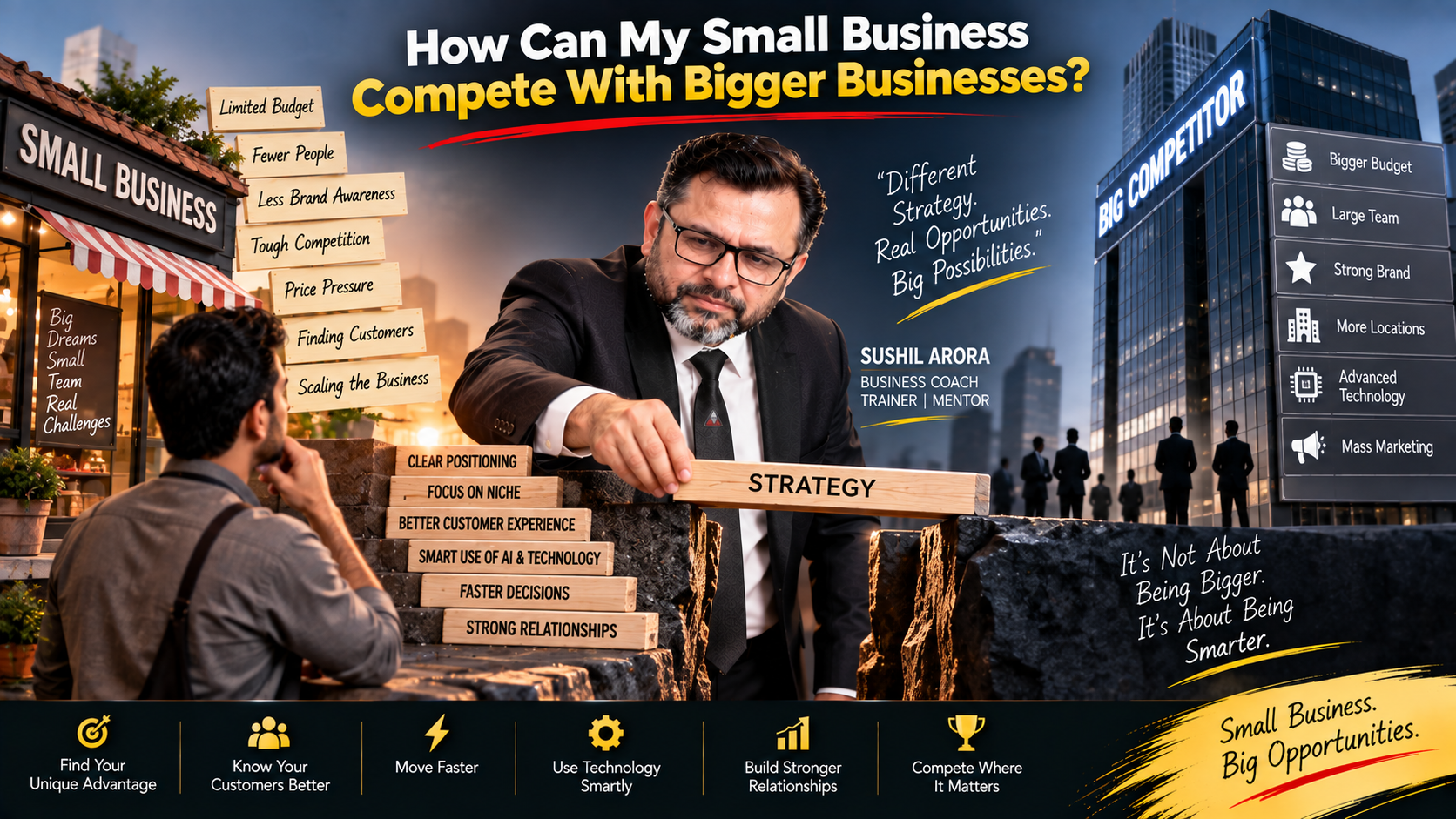
🏢 “How Am I Supposed to Compete With a Company That Has More Money, More People and a Bigger Brand?”
This is a question I hear from small business owners.
A large competitor enters the market.
They have a bigger advertising budget.
A larger sales team.
More locations.
Better technology.
More people.
They can sometimes offer lower prices.
Customers already know their name.
And the small business owner starts thinking:
“How Can My Small Business Compete With Bigger Businesses?”
My first response is:
🎯 “Why Are You Trying to Compete With Them on Their Terms?”
If a large company has a much bigger marketing budget, trying to outspend it may not make sense.
If it operates at a much larger scale, trying to beat it only on price can put pressure on your margins.
Being smaller creates disadvantages.
But it also means you can sometimes move faster, stay closer to customers and make changes without going through several layers of approval.
That is where I would look for an advantage.
💡 HOW I APPROACH COMPETITION — SUSHIL ARORA
🎯 When I work with a small business owner worried about a bigger competitor, I don’t begin by asking how we can copy the larger company. I first look at why customers currently choose this business, where the larger competitor is stronger, and where our smaller size gives us room to do something differently.
🔍 Then I help the owner choose where to compete. We may improve customer experience, focus on a specific customer group, respond faster, build stronger follow-up or use systems and technology to operate more efficiently. My aim is to give customers a clear reason to choose us rather than trying to look like a smaller copy of the biggest company in the market.
🔍 First, Stop Comparing the Size of the Businesses
Imagine you run a local company with 15 employees.
Your competitor has 2,000.
If every morning you compare:
Revenue.
Employees.
Marketing budget.
Locations.
Technology budget.
you will probably feel small.
But customers do not choose businesses by counting employees.
They choose based on what matters to them.
Price may matter.
But so may:
Response time.
Quality.
Convenience.
Specialized knowledge.
Trust.
Availability.
Service.
Customization.
Reliability.
So my first question would be:
🎯 “Why Should a Customer Choose You?”
If you cannot answer that clearly, this is the first business problem I would work on.
1. Don’t Try to Be Better at Everything
This is where small businesses often waste money.
They want:
Lower prices.
More products.
Faster delivery.
Better service.
More advertising.
More features.
More locations.
All at once.
A small business usually has limited resources.
So I would ask:
“Where Do We Actually Want to Win?”
Maybe your advantage is specialized service.
Maybe you serve one type of customer particularly well.
Maybe you can deliver faster in a specific area.
Maybe customers can speak directly with someone who understands their problem.
Maybe you offer something a large standardized business doesn’t handle well.
💡 You Don’t Need to Beat a Bigger Competitor Everywhere. You Need to Give the Right Customers a Strong Reason to Choose You Somewhere That Matters.
2. Know Your Customer More Closely
A small business can often stay much closer to its customers.
Use that.
Talk to them.
Ask:
💬 “Why Did You Choose Us?”
💬 “What Nearly Stopped You From Buying?”
💬 “What Do You Wish We Did Better?”
💬 “What Frustrates You About Other Options?”
I want real answers.
Not assumptions made inside a meeting room.
Suppose customers tell you:
“Your price isn’t the lowest, but when we call, someone actually solves our problem.”
That tells me something.
Customer support may be part of your competitive advantage.
🎯 Your Customers Can Tell You Where Your Real Advantage Already Exists.
3. Pick a Specific Customer Instead of Trying to Sell to Everyone
Large businesses often need large markets.
A smaller business may have more freedom to focus.
Suppose you sell software.
Instead of:
“Software for Every Business.”
you may decide to become particularly good at serving a specific type of company.
Then your:
Product.
Sales conversation.
Content.
Customer support.
Onboarding.
can become more relevant to that customer.
🔍 “Which Customer Can We Understand Better Than Our Bigger Competitor?”
That is a question I like.
💡 A Smaller Market Can Still Be a Good Business if You serve it well and the economics make sense.
4. Use Speed as an Advantage
Large businesses can have layers.
Employee.
Manager.
Department.
Approval.
Another approval.
Then action.
A smaller company may be able to move faster.
A customer gives useful feedback today.
Can you act on it this week?
A sales process is not working.
Can you change it quickly?
A new customer need appears.
Can you test a solution without waiting six months?
⚡ “How Quickly Can We Learn and Respond?”
That can be an advantage.
But only if the owner allows the team to make appropriate decisions.
If every small decision still needs your approval, your small business can become surprisingly slow.
5. Don’t Automatically Compete on Price
A bigger competitor may have purchasing power or scale that you do not have.
If they reduce prices and you immediately reduce yours, what happens?
Your margin falls.
Then they reduce again.
Your margin falls again.
Eventually, you may win the customer and still create a bad business outcome.
So before lowering prices, I would ask:
💰 “Is Price Really Why Customers Are Choosing Them?”
Find out.
Maybe the real issue is:
Your offer is unclear.
Your response is slow.
Your sales team does not follow up.
Your website creates doubt.
Your service is inconsistent.
Customers do not understand why you cost more.
🎯 Don’t Sacrifice Profit to Solve a Problem You Haven’t Properly Diagnosed.
6. Make Your Customer Experience Difficult to Copy
A big brand can copy a product.
It can reduce a price.
It can launch an advertisement.
But consistent customer experience can be harder to copy quickly.
Look at the complete journey:
Enquiry → Response → Conversation → Purchase → Delivery → Support → Follow-Up → Repeat Purchase
Where can you make this easier?
Maybe enquiries get answered faster.
Maybe customers always know who is handling them.
Maybe onboarding is clearer.
Maybe complaints are resolved properly.
Maybe you follow up after the sale instead of disappearing.
🤝 Small Businesses Often Have the Opportunity to Make Customers Feel Known Rather Than Processed.
Use that advantage carefully.
7. Become Easier to Buy From
Sometimes businesses focus too much on competitors and not enough on themselves.
I would test your own buying process.
How quickly does someone respond?
Is pricing understandable?
Can customers easily ask questions?
Is the proposal clear?
How complicated is payment?
What happens after payment?
Do customers know what comes next?
🎯 “Where Are We Making the Customer Work Too Hard to Buy From Us?”
Fix those points.
You may not need a new competitive strategy.
You may simply need a better buying experience.
8. Follow Up Better Than Bigger Competitors
A business spends money generating leads.
Then nobody follows up properly.
That is a waste.
A smaller team can build a disciplined follow-up process.
Lead Arrives → Owner Assigned → First Contact → Next Action → Follow-Up → Outcome
Use a CRM.
Create reminders.
Use automation where it makes sense.
Make sure genuine opportunities do not disappear because somebody forgot.
📞 A Bigger Marketing Budget Means Very Little if You Handle the Leads You Already Have Poorly.
Before spending more to compete, I would fix the leads already entering the business.
9. Build Relationships That Don’t End at the Sale
Small businesses sometimes spend most of their energy finding new customers.
But existing customers can be valuable.
Ask:
Do we follow up?
Do we understand why customers leave?
Do we make repeat buying easy?
Do we ask for feedback?
Do we stay useful after the first transaction?
🔄 “What Are We Doing After the Customer Pays Us?”
If the answer is:
“Nothing.”
I would work on that.
A strong customer relationship can reduce the need to win every future sale from zero.
10. Make Your Expertise Visible
If you understand a customer’s problem deeply, don’t keep all that knowledge inside the business.
Explain it.
Write about common problems.
Answer customer questions.
Create useful videos.
Share practical examples.
Explain mistakes customers should avoid.
🧠 Teach Before You Try to Sell Every Time.
This gives potential customers a chance to understand how you think.
For a smaller business, that can help build trust before the first conversation.
11. Use AI to Reduce the Resource Gap
This is where technology can help a small business.
You may not have a large:
Marketing department.
Analytics team.
Content team.
Administrative team.
Sales operations department.
AI cannot simply replace all of those people.
But it can support parts of the work.
For example:
🤖 Drafting routine content
📊 Summarizing reports
💬 Drafting customer communication
📝 Summarizing meetings
🔍 Organizing customer feedback
📞 Supporting follow-up
📚 Helping organize internal information
I would ask:
🎯 “Which Repetitive Work Is Taking Time Away From the Things Our Small Team Does Best?”
That is where I would consider AI.
💡 Use AI to Help a Small Team handle more routine work without making the customer experience feel automated everywhere.
12. Automate the Work Customers Don’t Need You Personally to Do
A customer does not need you personally to:
Create every reminder.
Enter every CRM record.
Schedule every routine follow-up.
Prepare every basic report.
Send every confirmation.
These can often be supported by systems or automation.
Then your people have more time for:
Customer conversations.
Problem solving.
Sales.
Quality.
Relationships.
⚙️ Automate the Repetition. Keep People Where Human Attention Creates Value.
13. Build Systems Before Growth Makes the Business Messy
A small business sometimes survives through effort.
The owner remembers everything.
Employees ask the owner.
Customer information sits in WhatsApp.
Processes are informal.
That may work with 20 customers.
It becomes difficult with 200.
If you want to compete with larger businesses, I want your operations becoming more disciplined before growth forces the issue.
Create:
Clear responsibilities.
Basic processes.
Useful reporting.
Customer records.
Follow-up systems.
Decision rules.
📈 Being Small Should Make You Flexible. It Shouldn’t Mean Being Disorganized.
14. Learn From Bigger Competitors Without Copying Them
I absolutely want to study competitors.
Look at:
What customers like about them.
What they communicate well.
How easy they make buying.
Where they appear stronger.
What customers complain about.
But don’t automatically copy every feature.
Ask:
🔍 “Why Does This Work for Them, and Would It Make Sense for Our Customer?”
A process designed for a company with thousands of employees may be completely unnecessary for you.
💡 Learn From Bigger Businesses. Keep What Fits. Ignore What Doesn’t.
15. Measure What Customers Actually Value
You may think your biggest advantage is quality.
Customers may care more about speed.
You may think they love your personal service.
They may actually stay because your product is easier to use.
You may think they leave because of price.
They may leave because support is slow.
So measure where possible.
Ask customers.
Track complaints.
Record lost-sale reasons.
Look at repeat purchases.
Look at conversion.
📊 Your Competitive Advantage Should Come From Customer Evidence, Not Just What You Want to Believe About Your Business.
🚀 How I Would Help a Small Business Compete With a Bigger Company
If you came to me and said:
“Sushil Sir, A Much Bigger Competitor Is Taking Customers. What Would You Do?”
I would not immediately recommend spending more on marketing.
I would work through it in this order.
🔍 Step 1: Understand Why Customers Are Choosing the Competitor
I want evidence.
Price?
Trust?
Product?
Availability?
Convenience?
Speed?
Service?
Brand recognition?
Something else?
Until we understand that, we are guessing.
🎯 Step 2: Identify Where We Can Realistically Win
I would ask:
Where Are We Already Strong?
Where Is the Competitor Weak?
What Matters Most to Our Best Customers?
Which Customer Group Fits Us Best?
Then choose the battleground.
👥 Step 3: Get Closer to Customers
Talk to customers.
Talk to lost prospects.
Talk to the sales team.
Talk to customer service.
Find repeated patterns.
💡 Step 4: Make the Difference Clear
If your business is better for a certain customer, that customer needs to understand why.
Make it clear in:
Your website.
Sales conversations.
Proposals.
Content.
Customer experience.
⚙️ Step 5: Fix Operational Weaknesses
Being small is not an excuse for:
Slow replies.
Missed follow-ups.
Poor records.
Late delivery.
Unclear responsibilities.
Fix those.
🤖 Step 6: Use Technology Where It Gives the Team Leverage
Automate routine work.
Use AI for suitable drafting, summarizing and information tasks.
Improve customer records.
Improve follow-up.
Give employees better access to useful information.
🤝 Step 7: Strengthen Customer Retention
Don’t only ask:
“How Do We Win Their Customers?”
Also ask:
“Why Would Our Existing Customers Ever Want to Leave Us?”
Fix those reasons.
📊 Step 8: Measure Whether the Strategy Is Working
Look at relevant measures.
Conversion.
Repeat business.
Customer retention.
Response times.
Margins.
Lost-sale reasons.
Customer feedback.
Then adjust.
🎯 Competing Better Should Eventually Appear in the Business, Not Just in the strategy presentation.
⚠️ The Mistake I Want Small Business Owners to Avoid
The biggest mistake is looking at a larger competitor and thinking:
“We Need to Become More Like Them.”
Maybe you don’t.
Customers already have the option of buying from them.
Why should they choose a smaller copy?
I would rather ask:
🎯 “What Can We Give the Right Customer That This Bigger Business Is Not Giving Them Well Enough?”
Maybe it is specialization.
Maybe speed.
Maybe access.
Maybe service.
Maybe flexibility.
Maybe a better understanding of a particular problem.
Find it.
Then build around it.
💡 HOW I LOOK AT SMALL-BUSINESS COMPETITION — SUSHIL ARORA
🎯 When I work with a smaller business facing a larger competitor, I don’t try to turn the small company into a large company overnight. I identify where being smaller can actually help us and where our systems need to become stronger.
🔍 I look at customers first. Why do they buy? Why do they leave? What does the competitor do better? Where are customers still frustrated? Then we choose the areas where this business can realistically be better.
⚙️ From there, I improve the process, give the team clearer responsibility and use technology where it saves time or improves consistency. The aim is to compete intelligently rather than trying to match a larger company’s spending.
🧠 Your Small Size Can Be Useful Only if You Use It
People often say:
“Small Businesses Are More Flexible.”
That isn’t automatically true.
A small business where every decision needs the owner can be very slow.
A small business with poor systems can give terrible service.
A small business that ignores customers can be just as disconnected as a large one.
So don’t assume being small is an advantage.
Turn it into one.
⚡ Make Decisions Faster.
🤝 Stay Closer to Customers.
🔄 Adapt When You Learn Something.
🎯 Give Employees Enough Authority to Solve Problems.
That is how size becomes useful.
📈 Don’t Measure Success by Whether You Become as Big as Your Competitor
Your competitor may have 50 locations.
Do you need 50?
Maybe.
Maybe not.
The better questions are:
Is the Business Profitable?
Are the Right Customers Choosing Us?
Are Customers Staying?
Can We grow without quality falling?
Can the business operate without everything depending on me?
Are we building something customers genuinely value?
That is what I would focus on.
💬 Final Thoughts From Sushil Arora
If you’re asking:
“How Can My Small Business Compete With Bigger Businesses?”
stop beginning with their size.
Begin with your customer.
🎯 Why Do Customers Choose Us Today?
🔍 Why Do Some Choose the Bigger Competitor?
👥 Which Customers Are the Best Fit for Us?
⚡ Where Can We Move Faster?
🤝 Where Can We Give Better Service?
💰 Are We Competing on Price When We Shouldn’t Be?
📞 Are We following up properly?
🔄 Are We keeping the customers we already have?
⚙️ Are weak systems making our small business slower than it should be?
🤖 Can technology help our team do more without losing the personal customer experience?
Then choose where you want to compete.
Don’t copy a bigger competitor just because they are bigger.
Don’t cut prices before understanding why customers are leaving.
Don’t try to serve everyone.
Don’t let poor systems waste the flexibility of being small.
Don’t spend more on finding customers while ignoring the ones you already have.
🎯 Your Next Step
Take your strongest larger competitor.
Then answer these questions:
👉 What Do They Clearly Do Better Than Us?
👉 Why Do Customers Choose Them?
👉 What Do Their Customers Complain About?
👉 What Do Our Best Customers Value About Us?
👉 Which Type of Customer Do We Understand Particularly Well?
👉 Where Can We Respond Faster?
👉 Where Can We Give a Better Experience?
👉 Which Internal weakness is stopping us from doing that today?
👉 What can technology help us improve without making the experience worse?
Then ask yourself:
🎯 “If I Cannot Outspend This Competitor, Where Can I Outserve, Outspecialize or Outexecute Them for the Customers I Actually Want?”
Choose one area.
Make it better.
Measure whether customers notice.
Then keep improving it.
💡 MY SMALL-BUSINESS COMPETITION PHILOSOPHY — SUSHIL ARORA
🏢 I don’t believe a small business wins by pretending to be a large business. A bigger competitor will often have resources you simply don’t have, and ignoring that reality leads to bad decisions.
🎯 My approach is to understand the customer better, choose a specific place to compete, strengthen the processes behind that promise and use systems, automation and AI where they allow a smaller team to work more effectively.
🤝 You don’t need every customer in the market. You need the right customers to understand why your business is the better choice for them, and then you need to deliver on that reason consistently.
— Sushil Arora