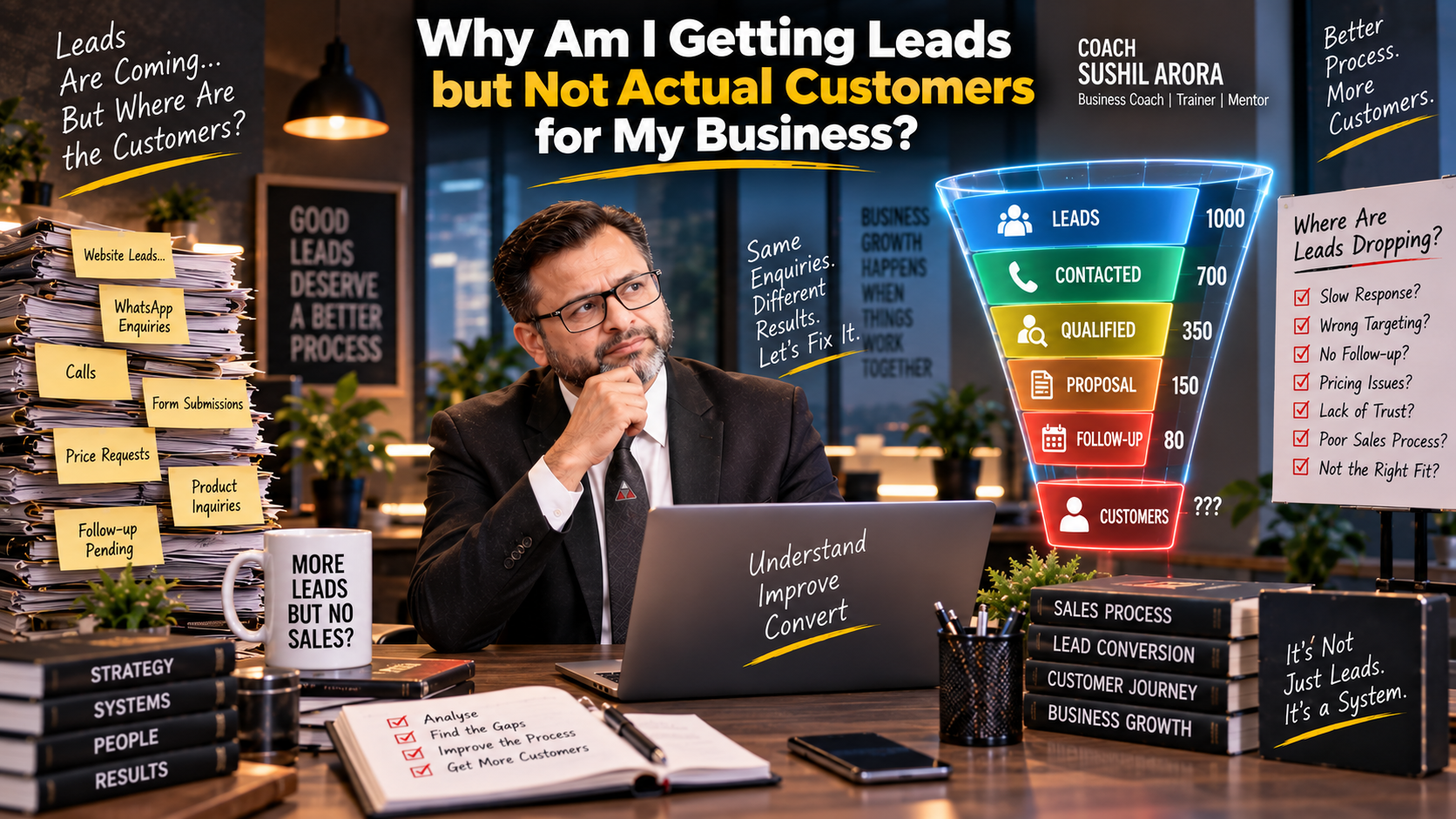
📞 “I’m Getting Leads, but Why Aren’t They Becoming Customers?”
This is a frustrating situation for any business owner.
Your marketing seems to be doing its job.
Enquiries are coming in. People are filling out forms, sending WhatsApp messages, calling your team, or asking for prices.
On paper, things look active.
But at the end of the month, you look at actual sales and think:
“If We’re Getting So Many Leads, Where Are the Customers?”
This is where I want business owners to be careful.
The first reaction is often to blame the leads.
“These aren’t good leads.”
“People are just asking for prices.”
“Nobody is serious.”
Sometimes lead quality genuinely is poor.
But I wouldn’t accept that explanation until I had looked at what happens after a lead enters the business.
If you came to me and said:
👉 “Sushil Sir, I’m Getting Leads but Not Customers. What Am I Doing Wrong?”
I would start with one question:
🎯 “At What Point Are These Leads Dropping Out?”
Because getting a lead is only the beginning.
The real question is what your business does with that opportunity.
💡 HOW I APPROACH A LEAD-CONVERSION PROBLEM — SUSHIL ARORA
🔍 When a business owner tells me leads are coming in but customers aren’t, I don’t immediately recommend more advertising. I first follow those leads through the sales process. I want to see how quickly the team responds, what they ask, how they follow up, why prospects say no, and where the conversation usually stops.
🎯 Once I find the point where good opportunities are being lost, that’s where I start fixing the process.
🔍 The Lead May Not Be the Real Problem
Let’s take a simple example.
Suppose your business generates 300 leads in a month.
Your sales team converts 12 of them.
That means 288 didn’t become customers.
The easy response is:
“We Need Better Leads.”
Maybe.
But I would first ask:
👉 “What Happened to Those 288 Leads?”
How many were actually contacted?
How many answered?
How many were qualified?
How many received a proper sales conversation?
How many were followed up more than once?
How many said no?
And most importantly:
Do You Know Why They Said No?
If you can’t answer these questions, you don’t yet know whether you have a lead-quality problem or a sales-process problem.
💡 Don’t Call Every Lost Opportunity a Bad Lead Until You Know What Happened to It.
📊 Where I Look When Leads Aren’t Becoming Customers
I break the process down like this:
Lead → Response → Qualification → Conversation → Follow-Up → Decision → Customer
Then I look at the numbers at every stage.
If 300 leads enter the process but only 150 are contacted, that’s one problem.
If 280 are contacted but only 80 are relevant, that’s another.
If 200 are qualified but only 30 receive proper follow-up, that’s another.
And if plenty of qualified prospects reach the final stage but still don’t buy, I need to understand what is happening in the sales conversation or offer.
🎯 “Where Is the Biggest Drop?”
That’s the point I would investigate first.
1. Your Team May Be Responding Too Slowly
Think about what happens when somebody enquires.
Do they receive a response quickly?
Or does the lead sit there until someone gets time?
A customer who is actively looking for a solution may contact several businesses.
If your team responds much later, the customer may already be speaking seriously with someone else.
I would check:
⏱️ When did the lead arrive?
📞 When was the first contact attempt?
💬 What response did the customer receive?
📋 Who was responsible for the lead?
If nobody knows, that’s already useful information.
👉 “How Long Does a New Lead Wait Before Someone From My Business Actually Speaks to Them?”
You don’t need your team sitting beside the phone every second.
But you do need a clear response process.
⚡ A Lead Shouldn’t Become Cold While It Is Waiting Inside Your Own Business.
2. Your Salesperson May Be Pitching Before Understanding the Customer
A lead answers the phone.
The salesperson immediately starts:
“Sir, we provide…”
“Our company has…”
“Our package includes…”
“The price is…”
But nobody has asked why the customer enquired.
I would rather hear the salesperson ask:
💬 “What Are You Looking For?”
💬 “What Problem Are You Trying to Solve?”
💬 “What Is Most Important to You When Choosing This?”
The answers help the salesperson understand whether the person is a genuine fit and what matters to them.
Then the conversation can focus on what is relevant.
🎯 Don’t Rush to Explain Your Product Before You Understand Why the Customer Is Talking to You.
A sales conversation should feel like a conversation.
Not a recorded pitch delivered to everyone who answers the phone.
3. You May Be Treating Every Lead as Equal
Not every enquiry has the same intent.
One person may be ready to buy today.
Another is comparing prices.
Someone else is researching for next month.
Another person may simply be curious.
If your team treats all four people exactly the same way, good opportunities can get lost.
This is why I would introduce basic lead qualification.
The team should understand things such as:
What does the customer need?
Is your solution relevant?
When do they expect to make a decision?
Who is involved in that decision?
What is stopping them from moving forward?
🔍 “Is This a Bad Lead, or Is This Simply a Customer Who Isn’t Ready Yet?”
Those are different situations.
Your sales process should recognise the difference.
4. Your Follow-Up May Be the Real Leak
This is one of the first areas I would inspect.
A lead enquires on Monday.
The salesperson calls.
The customer says:
“Send me the details. I’ll check.”
The details are sent.
Then nothing happens.
A week later, the owner asks:
“What happened to that lead?”
The salesperson says:
“They didn’t respond.”
But did we follow up?
That question often changes the conversation.
📞 “How Many Leads Are We Losing Because Nobody Made the Second or Third Contact?”
A customer may be busy.
They may need time.
They may have forgotten.
They may have another question.
That doesn’t mean your team should keep chasing someone forever.
It means every genuine opportunity should have a clear next step.
⚙️ Lead → Last Conversation → Next Action → Follow-Up Date → Outcome
I want the salesperson to know what happens next.
And I want the business owner to be able to see it.
💡 Follow-Up Shouldn’t Depend on Someone Remembering.
5. Your Leads May Actually Be Poor Quality
Yes, this can happen too.
Not every conversion problem comes from the sales team.
Maybe your advertising is attracting people who were never likely to buy.
Suppose your advertisement focuses heavily on:
“Lowest price.”
You may attract a large number of people mainly interested in finding the cheapest option.
Then your sales team complains:
“Everyone is asking for discounts.”
That may be connected to the message attracting those people in the first place.
I would compare lead sources.
📊 Which Channel Produces Leads?
📊 Which Channel Produces Qualified Leads?
📊 Which Channel Actually Produces Customers?
These are not the same question.
One campaign may produce 500 leads and 5 customers.
Another may produce 100 leads and 15 customers.
If you only celebrate lead volume, you can easily choose the wrong campaign.
🎯 I Would Rather Understand Which Source Produces Customers Than Simply Which Source Produces the Most Leads.
6. Your Offer May Not Be Clear Enough
Sometimes the lead is good.
The response is quick.
The salesperson follows up.
Still, people aren’t buying.
Then I want to look at the offer itself.
Does the customer clearly understand what they are getting?
Is the value easy to understand?
Does the offer solve the problem that brought them to you?
Is the buying process unnecessarily complicated?
Are customers repeatedly raising the same objection?
👉 “What Is Making the Customer Hesitate?”
This is where lost-sale information becomes useful.
If many prospects are confused about the same thing, the business should pay attention.
If many say the offer doesn’t fit their needs, investigate it.
If price repeatedly comes up, understand whether the issue is affordability, poor value communication, or a mismatch between the offer and the audience.
Don’t guess.
Ask, record and review.
7. Customers May Not Trust You Enough Yet
Imagine someone has found your business for the first time.
They don’t know you.
They don’t know whether your claims are reliable.
They may be comparing you with other businesses.
And you’re asking them to spend money.
Trust matters.
I would look at what the customer sees during the decision process.
Is your communication clear?
Does the salesperson answer questions properly?
Do you explain what happens after purchase?
Are your policies understandable?
Do you have genuine reviews, testimonials or customer experiences you are allowed to share?
Are you making promises you can actually keep?
🤝 “What Does the Customer Need to Know Before They Feel Comfortable Saying Yes?”
That’s a better way to think about trust.
Don’t try to manufacture it with exaggerated claims.
Make the decision easier to understand.
8. Your Sales Team May Be Focused on Activity Instead of Progress
I sometimes see sales reports like this:
100 calls made.
80 WhatsApp messages sent.
50 emails sent.
Fine.
But what happened?
How many conversations moved forward?
How many qualified opportunities exist?
How many follow-ups are due?
How many proposals are being considered?
Why were deals lost?
📊 “Are We Measuring How Busy the Sales Team Is, or Whether Leads Are Moving Toward a Decision?”
Activity matters.
But activity without progress can give the owner a false sense that the sales process is working.
I want to see movement.
🚀 How I Would Turn More Leads Into Customers
If a business owner came to me with plenty of leads but poor conversion, this is how I would work through it.
🔍 Step 1: Map the Existing Lead Journey
I would take a sample of recent leads and follow what happened.
Where did each lead come from?
How quickly was it contacted?
Was it qualified?
What did the salesperson discuss?
How many follow-ups happened?
What was the final outcome?
📊 Step 2: Find the Biggest Drop
Maybe the problem is between:
Lead → Contact
or:
Contact → Qualification
or:
Qualification → Follow-Up
or:
Follow-Up → Sale
I want to know where the biggest loss is happening.
🎯 Step 3: Understand Why Leads Are Dropping Out
Numbers tell me where.
Conversations tell me why.
I would review the reasons leads aren’t moving forward.
Price?
Timing?
Poor fit?
Competitor?
No response?
Lack of trust?
Unclear offer?
No follow-up?
🛠️ Step 4: Fix the Weakest Part First
If response time is poor, fix lead assignment and response.
If qualification is weak, give the team better questions.
If the sales conversation is weak, coach the team.
If follow-up is inconsistent, create a follow-up process.
If lead quality is poor, work with marketing on targeting and messaging.
If trust is weak, improve how the business communicates proof and expectations.
⚙️ Step 5: Give Every Lead an Owner and a Next Action
I don’t want leads sitting in a spreadsheet with no clear responsibility.
Every active lead should have:
Owner → Current Stage → Last Contact → Next Action → Follow-Up Date
That alone can make the sales process much easier to manage.
📈 Step 6: Measure Conversion at Each Stage
Don’t look only at:
Total leads → Total customers
Look inside the process.
Leads → Contacted → Qualified → Followed Up → Proposals/Decisions → Customers
Now you can see where improvement is happening.
🔄 Step 7: Review Lost Leads
Once a week or once a month, depending on the business, I would review lost opportunities.
Not to blame people.
To learn.
🎯 “Why Are We Losing Deals, and Is There a Pattern We Can Fix?”
That’s where sales improvement becomes practical.
⚠️ The Mistake I Want Business Owners to Avoid
When leads aren’t converting, the quickest reaction is often:
“Marketing Isn’t Giving Us Good Leads.”
Marketing may genuinely need improvement.
But don’t stop there.
If you replace the marketing agency tomorrow and generate another 500 leads, what happens when those leads enter the same sales process?
If response is still slow, they may be lost.
If follow-up is still weak, they may be lost.
If the sales conversation is poor, they may be lost.
👉 Don’t Keep Buying More Leads Until You Understand What Your Business Is Doing With the Leads It Already Has.
Sometimes the cheapest new customer is hiding inside the leads you’ve already generated.
💡 HOW I LOOK AT LEAD CONVERSION — SUSHIL ARORA
When I see a business generating leads without enough customers, I don’t want to argue about whether marketing or sales is to blame. I want to follow the customer journey and find where the opportunity is being lost.
Once I know whether the problem is lead quality, response time, qualification, sales conversations, follow-up, trust or the offer itself, I can work on the right part of the process. That’s far more useful than simply telling the team to “convert more.”
For me, a lead isn’t a result.
It is an opportunity.
What happens after that opportunity enters the business is what matters.
📈 Stop Celebrating Leads Until You Know What They Produce
A marketing report may say:
1,000 leads generated.
That sounds impressive.
But I want to know:
How Many Were Qualified?
How Many Received Proper Follow-Up?
How Many Became Customers?
How Much Did Those Customers Actually Contribute to the Business?
Lead volume alone can hide a weak process.
This doesn’t mean leads don’t matter.
They do.
But they are one part of the customer journey.
💡 The Goal of Marketing Isn’t to Fill a Spreadsheet. The Business Needs the Right Opportunities and a Sales Process That Knows What to Do With Them.
💬 Final Thoughts From Sushil Arora
If you’re asking:
“Why Am I Getting Leads but Not Actual Customers for My Business?”
Don’t immediately buy more leads.
Start by looking at what happens to the leads you already have.
⚡ How Quickly Are They Contacted?
🎯 Are They Actually Qualified?
💬 Does the Salesperson Understand What They Need?
📞 Does Someone Follow Up?
🤝 Do They Trust the Business Enough to Buy?
📊 Do You Know Why Lost Leads Didn’t Convert?
The answers will tell you much more than the total lead count.
Don’t Blame Lead Quality Before Checking the Sales Process.
Don’t Blame Sales Before Checking Lead Quality.
Don’t Guess Why Customers Say No. Find Out.
Don’t Let Follow-Up Depend on Memory.
Don’t Measure Leads Without Measuring Customers.
🎯 Your Next Step
Take your last 50 or 100 leads.
Don’t look at them as one number.
Go through them.
👉 How Many Were Contacted?
👉 How Quickly Were They Contacted?
👉 How Many Were Actually Relevant to the Business?
👉 How Many Received More Than One Follow-Up?
👉 How Many Had a Serious Sales Conversation?
👉 How Many Became Customers?
👉 Why Did the Others Not Buy?
Then ask yourself:
🎯 “Where Am I Losing the Largest Number of Genuine Opportunities?”
That is where I would start.
Because if you fix the biggest leak in the process, the leads you’re already generating have a better chance of becoming customers.
💡 MY LEAD-TO-CUSTOMER PHILOSOPHY — SUSHIL ARORA
🔍 I don’t look at lead generation and sales conversion as two completely separate problems. I want to understand the whole journey from the moment someone shows interest to the moment they decide whether to buy.
🎯 My approach is to find where genuine opportunities are being lost, understand why, fix that part of the process, give the team clear responsibility, and then measure whether conversion improves.
📈 Before spending more money generating leads, I want the business to become better at handling the right leads it already receives.
— Coach Sushil Arora