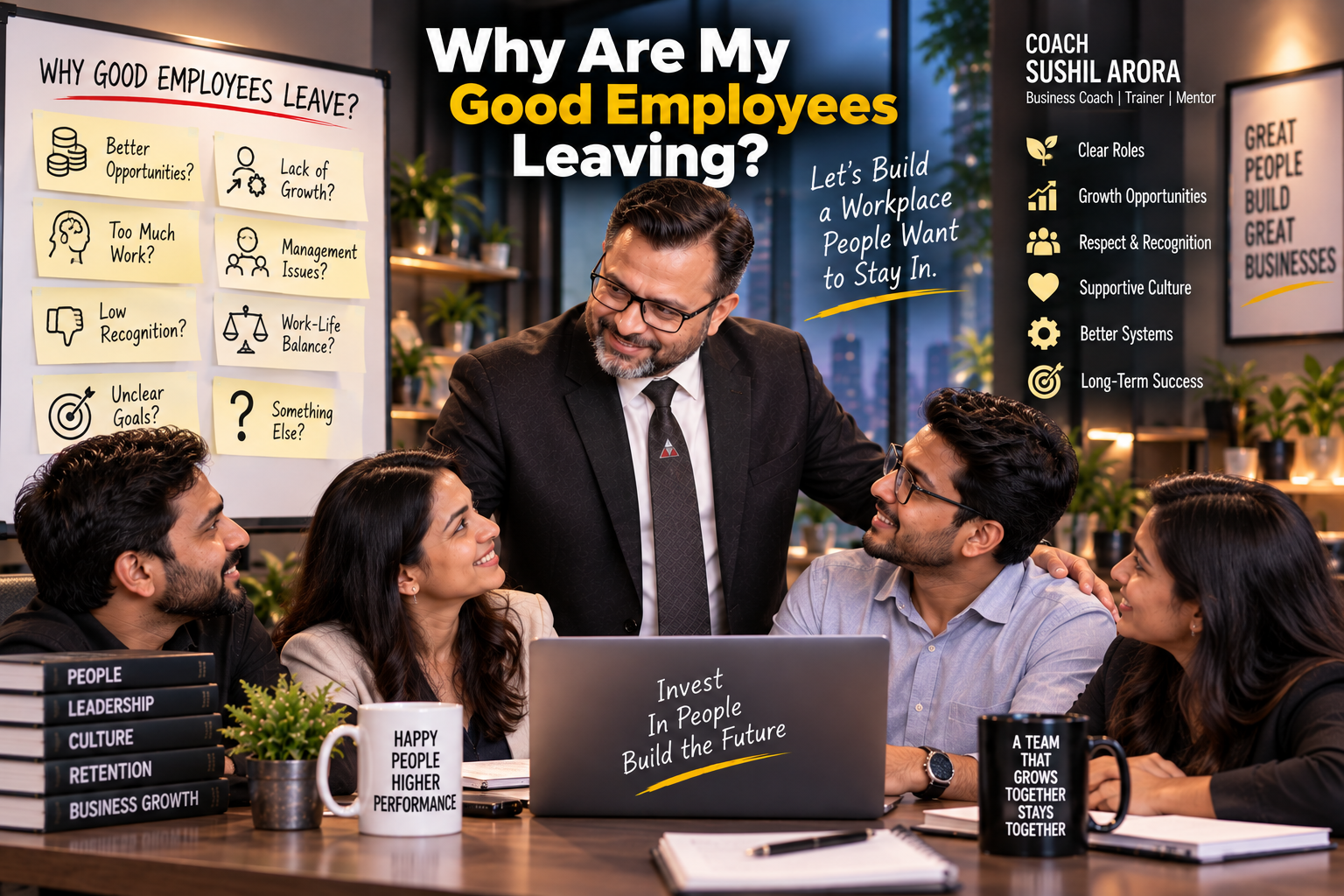
👥 “Why Are the Employees I Actually Want to Keep the Ones Who Are Leaving?”
Losing an employee is difficult.
Losing a good employee is different.
This is someone who understands the work.
You trust them.
Customers may know them.
Other employees depend on them.
They don’t need to be reminded about every small task.
Then one day, they ask for a meeting.
And you hear:
“Sir, I’ve Decided to Leave.”
Your first thought may be:
“Why?”
Your second may be:
“What do I need to offer them to stay?”
And after it happens a few times, the question becomes bigger:
“Why Are My Good Employees Leaving?”
When a business owner brings this problem to me, I don’t immediately assume it is salary.
Salary can absolutely be part of the reason.
But before increasing everyone’s salary or making promises to one employee who has already resigned, I want to understand what made a good employee start looking elsewhere in the first place.
🎯 “What Changed Between the Day This Person Was Happy to Join Us and the Day They Decided They Wanted to Leave?”
That is where I would start.
💡 HOW I APPROACH EMPLOYEE RETENTION — SUSHIL ARORA
👥 When a business owner tells me good employees are leaving, I don’t start by asking, “How much more money will make them stay?” I first look for patterns. Who is leaving? From which roles? Under which managers? After how long? And what reasons are employees actually giving us?
🔍 Then I look at the working experience behind those numbers: management, workload, recognition, growth, pay, role clarity, flexibility where possible, and whether employees feel they can do good work without constant frustration. I want to fix the reason good people want to leave, not simply react after they resign.
🔍 One Resignation Is an Event. Repeated Resignations Are Information.
Suppose one strong salesperson resigns.
Maybe they received an opportunity your business couldn’t reasonably match.
That happens.
But suppose three of your strongest salespeople leave within a year.
Now I am interested.
Or several employees keep leaving one particular department.
Or good employees usually leave after 12 to 18 months.
Or new hires stay, but your experienced people are disappearing.
These patterns tell us something.
👉 “Who Is Leaving, and What Do These Employees Have in Common?”
I don’t want the owner saying:
“People aren’t loyal anymore.”
That doesn’t help me solve anything.
I want information.
💡 If Good Employees Keep Leaving, Don’t Start With an Assumption. Start With the Pattern.
1. Ask Why People Are Leaving Before Deciding Why
This sounds obvious.
But owners often create their own explanation.
“They left for money.”
“Young employees keep changing jobs.”
“They got a bigger company.”
Maybe.
But what did the employee actually say?
And even then, I wouldn’t stop at the first answer.
An employee may say:
“I got a better opportunity.”
That’s understandable.
But what made the other opportunity better for them?
Pay?
Role?
Manager?
Learning?
Responsibility?
Working conditions?
Career direction?
A combination?
💬 “What Would Have Needed to Be Different for You to Seriously Consider Staying?”
That can be a useful question during an honest exit conversation.
I wouldn’t argue with the answer.
I would listen.
Because the purpose isn’t to win the conversation.
The purpose is to learn something about the business.
2. Don’t Wait for the Resignation Letter to Ask Whether Someone Is Happy
This is one of the first things I would change.
Many companies conduct an exit interview after the employee has already accepted another offer.
At that point, we’re learning late.
I would rather speak with good employees while they are still working with us.
Ask:
💬 “What’s Working Well for You Here?”
💬 “What’s Making Your Job Harder Than It Needs to Be?”
💬 “Is There Anything That Is Making You Think About Leaving?”
💬 “What Would You Like to Learn or Take More Responsibility For?”
These don’t need to become formal two-hour meetings.
A manager who regularly talks to employees can learn a lot before frustration becomes resignation.
🎯 Don’t Make the Exit Interview the First Honest Conversation You Have With a Good Employee.
3. Your Best Employees May Be Carrying Too Much Work
This happens quietly.
A reliable employee gets work done.
So when something important appears, who gets it?
The reliable employee.
Another employee misses a deadline.
Who fixes it?
The reliable employee.
A difficult customer needs handling.
Who gets the customer?
The reliable employee.
A new employee needs help.
Who trains them?
The reliable employee.
Eventually, being good at your job becomes a reward of more work.
Then the owner is surprised when that employee becomes tired or starts looking elsewhere.
I would ask:
⚖️ “Are My Best Employees Being Rewarded for Good Performance, or Simply Being Given Everyone Else’s Problems?”
Good employees can handle responsibility.
Many of them want responsibility.
But there is a difference between meaningful responsibility and endless overload.
💡 Don’t Turn Reliability Into a Reason to Keep Adding Work Without Reviewing Capacity.
4. A Manager May Be the Reason a Good Employee Leaves
This can be uncomfortable for an owner.
You may have a strong department manager.
Targets are being achieved.
Reports look fine.
But what is it like to work for that person?
Does the manager communicate clearly?
Do they take credit for other people’s work?
Do they embarrass employees publicly?
Do they change priorities constantly?
Do they listen?
Do they micromanage capable people?
Do they give useful feedback?
Do they create unnecessary pressure?
If several good employees leave the same manager, I want to know.
🎯 “Are People Leaving the Company, or Are They Leaving a Management Experience Inside the Company?”
Don’t protect a manager simply because they deliver numbers.
Look at how those results are being produced.
5. Good Employees Need to Know Whether They Are Doing Well
Imagine doing good work for a year.
Deadlines are met.
Customers are happy.
You solve problems.
You help the team.
Nobody says much.
Then you make one mistake.
Suddenly, everyone notices.
That can become frustrating.
Recognition doesn’t need to mean trophies, announcements, or constant praise.
Sometimes it is simply:
“You handled that well. Here’s specifically what you did right.”
Or:
“You’ve taken ownership of this area consistently, and I’ve noticed it.”
Specific recognition matters more than empty:
“Good job.”
🤝 If You Notice Good Work Only When It Stops Happening, You’re Not Managing It Very Well.
6. Salary Matters, So Don’t Pretend It Doesn’t
I wouldn’t tell a business owner:
“Employees don’t care about money. They only want appreciation.”
That’s unrealistic.
People work partly because they need and want to earn.
If an employee’s pay is clearly out of line with their role, performance, responsibilities, or relevant market conditions, appreciation alone may not keep them.
So I would review compensation.
But I wouldn’t react by giving random raises whenever someone threatens to leave.
I would ask:
💰 “Do We Have a Sensible Way of Reviewing Pay and Responsibility?”
Employees should understand how compensation decisions are made as far as the business can reasonably explain them.
🎯 Fair Pay and Good Management Work Together. One Doesn’t Automatically Replace the Other.
7. Your Good Employees May Not See Anywhere to Grow
A capable employee joins.
They learn the job.
They perform well.
A year passes.
Then another.
Their title is the same.
Responsibilities barely change.
They’re learning very little.
They ask:
“What Comes Next for Me Here?”
And nobody has an answer.
I don’t believe every employee needs a promotion every year.
That isn’t realistic.
But good employees often want some sense that they are developing.
That might mean:
New skills.
Greater responsibility.
More difficult projects.
Leading part of a team.
Learning another part of the business.
A genuine promotion when a suitable opportunity exists.
📈 “Can This Employee See a Future Here, or Only More of the Same Work?”
If the answer is the second one, don’t be surprised when another company offers them the next step.
8. Stop Micromanaging Employees Who Have Earned Your Trust
This connects directly with productivity.
A capable employee knows their work.
But every email needs approval.
Every small decision needs approval.
Every customer conversation is questioned.
Every task is checked repeatedly.
Eventually, the employee thinks:
“If You Don’t Trust Me to Do the Job, Why Am I Responsible for It?”
I want clear accountability.
But accountability and micromanagement are different.
I would define:
Result → Authority → Boundaries → Review
Then let capable employees work.
🔑 As an Employee Proves They Can Handle More Responsibility, Their Working Independence Should Usually Grow With It.
If you keep managing your strongest employee exactly like someone in their first week, frustration can build.
9. Fix the Small Frustrations Employees Face Every Day
Employees don’t always leave because of one dramatic event.
Sometimes they leave after months of small frustrations.
A slow approval process.
Poor software.
Unclear responsibilities.
Constant last-minute requests.
Meetings that waste time.
Other employees not doing their share.
Repeated customer problems nobody fixes.
Managers changing instructions.
Lack of information.
These things may look small from the owner’s office.
But employees experience them every day.
I would ask:
⚙️ “What Part of Your Work Wastes the Most Time or Creates the Most Unnecessary Frustration?”
Then I would listen for repeated answers.
💡 Sometimes Employee Retention Improves When You Simply Make It Easier for Good People to Do Good Work.
10. Don’t Confuse Happiness With No Accountability
This is important.
Keeping employees happy doesn’t mean:
No targets.
No deadlines.
No difficult conversations.
No performance standards.
No consequences.
Good employees often become frustrated when poor performance is ignored.
Imagine one employee consistently works hard.
Another regularly misses deadlines.
Both are treated exactly the same.
Who is more likely to become frustrated?
The person carrying their share.
🎯 “Are My Good Employees Having to Compensate for Performance Problems I Keep Avoiding?”
A productive workplace needs accountability.
Employees should know what is expected.
Managers should address performance problems fairly and consistently.
📊 Keeping Good Employees Doesn’t Mean Lowering Standards. It Means Making Standards Clear and Applying Them Properly.
11. Give People Some Control Over How They Do Their Work
Where the role allows it, employees often work better when every detail isn’t dictated to them.
Tell them the result.
Explain the boundaries.
Give them the information and resources they need.
Then allow them to think.
🧠 “What Do You Think We Should Do?”
I like asking capable employees this question.
It shows me how they think.
It also helps them develop judgement.
If their idea is better than mine, good.
The business benefits.
💡 If You Hire Capable People but Never Allow Them to Think, You’re Using Only Part of What You Hired.
12. Make Sure Good Employees Know Why Their Work Matters
People need to understand how their work connects with the business.
A customer-service employee shouldn’t feel that their job is simply answering messages.
They should understand how their work affects customer retention.
An operations employee should understand how their work affects delivery and customer experience.
A salesperson should understand what a healthy customer looks like for the business, rather than simply chasing any sale.
🎯 “Does This Employee Understand How Their Work Affects the Customer and the Business?”
That connection can make responsibilities clearer and improve decision-making.
🚀 How I Would Help a Business Keep Its Good Employees
If a business owner came to me and said:
“Sushil Sir, My Best Employees Are Leaving. How Would You Fix This?”
I wouldn’t begin with a team outing.
I wouldn’t begin with motivational posters.
And I wouldn’t begin by offering everyone more money.
I would diagnose the problem first.
🔍 Step 1: Study Who Is Actually Leaving
I would look at:
Which roles?
Which departments?
Which managers?
How long had they been with the company?
Were they strong performers?
What reasons did they give?
Do we see a pattern?
💬 Step 2: Speak to Good Employees Who Are Still Here
I want to know what keeps them.
And what might eventually push them away.
That gives us information before another resignation happens.
📊 Step 3: Separate the Retention Problems
Maybe we discover:
Compensation is an issue in one department.
Poor management is the issue in another.
High workload affects the strongest employees.
Some people see no development path.
Daily processes are creating unnecessary frustration.
Different problems need different solutions.
🎯 I Don’t Want One Retention Program for Five Different Retention Problems.
🛠️ Step 4: Fix the Biggest Reason First
If one manager is causing repeated resignations, work on management.
If pay is genuinely misaligned, review compensation.
If employees are overloaded, review workload.
If strong performers have nowhere to develop, work on responsibility and growth.
If daily processes are frustrating everyone, fix the process.
👥 Step 5: Make Managers Responsible for Retention Too
I don’t want employee retention sitting only with HR.
Managers shape much of the employee’s daily experience.
So I would expect managers to know:
Who is performing well?
Who is struggling?
Who is overloaded?
Who wants to develop?
Who seems disengaged?
What conversations have happened?
📈 Step 6: Create Development Conversations
I would regularly ask strong employees:
“What Would You Like to Become Better At?”
Then see where the employee’s interests and the business’s needs genuinely overlap.
Not every request can be fulfilled.
But the conversation should happen.
⚙️ Step 7: Remove Repeated Friction
Find the processes that annoy good employees every week.
Fix what can reasonably be fixed.
Don’t make employees fight the company system just to complete their jobs.
📊 Step 8: Track Whether Retention Actually Improves
After making changes, I want to know:
Are good employees staying longer?
Are resignation reasons changing?
Is one department still losing people?
Are managers improving?
Are employee concerns being resolved earlier?
🔄 Don’t Launch an Employee-Retention Initiative and Assume It Worked Because Everyone Attended It. Measure What Changed.
⚠️ The Mistake I Want Business Owners to Avoid
The biggest mistake is reacting only after a good employee resigns.
Suddenly:
“What Salary Do You Want?”
“We’ll Promote You.”
“We’ll Reduce Your workload.”
“Why Didn’t You Tell Me You Were unhappy?”
But maybe they did.
Maybe they mentioned the workload.
Maybe they asked about growth.
Maybe they raised a management problem.
Maybe their signals were subtle.
Maybe nobody asked.
👉 Don’t Wait Until Someone Has Another Offer to Start Treating Them Like an Employee You Want to Keep.
Retention happens before resignation.
💡 HOW I LOOK AT KEEPING GOOD EMPLOYEES — SUSHIL ARORA
👥 When I work on employee retention, I don’t try to make everybody stay at any cost. People will leave businesses for many legitimate reasons, and no company can prevent every resignation.
🔍 What I want to prevent is avoidable loss. If capable employees are repeatedly leaving because of poor management, unclear growth, unfair workload, weak processes, ignored concerns or compensation problems, those are business issues we can examine and improve.
🎯 My approach is to find the pattern, listen before employees leave, fix the repeated causes and create a workplace where capable people can do useful work without unnecessary frustration.
🧠 Keeping Employees Happy Doesn’t Mean Keeping Them Comfortable All the Time
Business can be demanding.
There will be deadlines.
Customers will sometimes be difficult.
Targets will exist.
Mistakes will need discussing.
Employees may occasionally disagree with management decisions.
I don’t think the goal should be:
“How Do I Make Sure Nobody Is Ever Unhappy?”
That’s unrealistic.
I prefer:
🎯 “How Do I Create a Workplace Where People Are Treated Fairly, Know What Is Expected, Can Do Their Work Properly and Have a Reason to Keep Growing With Us?”
That’s a much more useful management goal.
📈 Happy Employees Aren’t Automatically Productive Employees
This distinction matters too.
An employee can enjoy the workplace and still perform poorly.
Another can produce strong results but be exhausted and close to leaving.
I want both sides.
Employee Experience + Clear Expectations + Accountability + Development + Sustainable Performance
The exact balance will vary by role and business.
But I don’t want an owner choosing between:
“Keep employees happy.”
and:
“Make employees productive.”
Good management should work on the conditions that support both.
🤝 What I Would Ask My Best Employees Before They Resign
If I owned a business and wanted to understand whether good people were likely to stay, I wouldn’t wait for HR to send me an annual report.
I would talk to them.
I would ask:
💬 “What Makes You Want to Continue Working Here?”
💬 “What Frustrates You Most About Working Here?”
💬 “Is There Something You Want to Learn or Take Responsibility For?”
💬 “Is There Anything About Your Workload We Need to Discuss?”
💬 “What Could Your Manager Do Differently to Help You Work Better?”
Then I would pay attention to repeated answers.
Because listening without acting on clear repeated problems eventually teaches employees that giving feedback isn’t worth their time.
💬 Final Thoughts From Sushil Arora
If you’re asking:
“Why Are My Good Employees Leaving, and What Can I Do to Keep Them Happy and Productive?”
Don’t start with perks.
Start with the employee’s actual working experience.
👥 Who Is Leaving?
🔍 Why Are They Leaving?
👔 Is One Manager Losing More Good People Than Others?
⚖️ Are Strong Employees Carrying Too Much Work?
💰 Is Compensation Reasonable for the role and responsibility?
📈 Can Good Employees See a Path to Develop?
🔑 Do Capable People Have Enough Trust and authority?
⚙️ Are Broken Processes Making their jobs unnecessarily difficult?
🤝 Do We Notice and recognise good work?
📊 Do We Deal fairly with poor performance elsewhere in the team?
Then act on what the answers tell you.
Don’t Assume Every Resignation Is About Money.
Don’t Ignore Money When It Really Is the Problem.
Don’t Reward Your Best Employees Only With More Work.
Don’t Wait for an Exit Interview to Start Listening.
Don’t Protect a Bad Manager at the Cost of Good Employees.
🎯 Your Next Step
Take the last five to ten employees who voluntarily left your business, if you have enough departures to review meaningfully.
Write down:
👉 Which Department Were They In?
👉 Who Managed Them?
👉 How Long Had They Worked With You?
👉 How Were They Performing Before They Left?
👉 What Reason Did They Give?
👉 Had They Raised Any Concerns Earlier?
👉 Did We Try to Address Those Concerns?
👉 Are the Same Reasons Appearing More Than Once?
Then look at your strongest employees who are still with you.
Ask:
👉 Are They Carrying Too Much?
👉 When Did Their Manager Last Have a Proper Conversation With Them?
👉 Do They Know What Their Next opportunity here could look like?
👉 Have We Recognised what they are contributing?
👉 Is there a recurring frustration we already know about but haven’t fixed?
Finally, ask yourself:
🎯 “If My Best Employee Resigned Tomorrow, Would I Be Genuinely Surprised, or Have There Already Been Signs I Haven’t Paid Enough Attention To?”
Don’t wait for the resignation letter to find out.
Talk to the people you want to keep.
Understand what helps them perform.
Understand what frustrates them.
Fix the problems that are within the business’s control.
And make sure good employees can see that strong performance leads somewhere.
💡 MY EMPLOYEE-RETENTION PHILOSOPHY — SUSHIL ARORA
👥 I don’t believe a business can or should try to keep every employee forever. People move for personal reasons, career opportunities and circumstances that a company cannot always control.
🔍 What I focus on is the turnover the business can influence. I look for repeated reasons good employees leave, identify whether the problem sits in management, workload, compensation, growth, recognition or the way work is organized, and then improve the process behind it.
🎯 For me, keeping good employees isn’t about making work easy. It’s about creating a place where capable people can do meaningful work, understand what is expected, develop their skills, receive fair treatment and see a reason to continue contributing.
— Coach Sushil Arora